Filtre

Type the word you want to search for
3 minute reading time
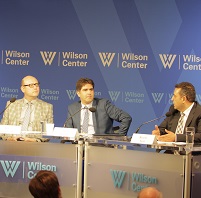
ORSAM in collaboration with the Woodrow Wilson International Center for Scholars organized a panel entitled “Turkey, Iraq and Kurdistan Regional Government”. The panel took place on August 25th 2014 in Washington D.C. The panel analyzed the most recent developments in the Kurdistan Regional Government (KRG), future of Iraq after the ISIS threat and perspective of Turkey on recent events. The panel was presented by Christian F. Osterman, Director of the History and Public Policy Program (HAPP) and moderated by Ali Resul Usul, President of the Center of Strategic Research (SAM). The panel consisted of three speakers: Bülent Aras (Global Fellow Chairman at the Wilson Center), Şaban Kardaş (President of ORSAM), and Dlawer Ala’Aldeen (President of the Middle East Research Institute based in Erbil). Each of the speakers focused their presentation on a particular topic before the floor was opened for the members of the audience to formulate their questions to the speakers.
Mr. Ala’Aldeen spoke in the first place, addressing the formation of the new Iraqi government headed by Prime Minister Al-Abadi in substitution of Al-Maliki and pointing out the main challenges that the new cabinet would have to deal with when formally approved: fight against the ISIS, the engagement of non-Shia groups, and the troubled relationship with the KRG. Ala’Aldeen stated that, despite the KRG had lost its confidence towards Baghdad, the Kurdish government still aimed to achieve greater sovereignty within an Iraqi federal state. Then, he said, the question of outright independence was not on the table yet. In reference to the ISIS, Ala’Aldeen considered that it does not only pose an existential threat for the region, but it should make regional powers to reconsider their policy over the last years towards Iraq and Syria.
Secondly, Şaban Kardaş examined Turkey’s views and foreign policy towards the current developments, considering that the emergence of ISIS in both Iraq and Syria since June 2014 had retrospectively strengthened the previously criticized Turkish foreign policy in Iraq over the last years. Kardaş said that Mr. Abadi will face many challenges in the process of establishing a new government. Taking specifically on the relationship with the KRG, Kardaş declared it had been a success story since 2007.
Lastly, Bülent Aras focused his presentation on the situation of Turkmens in Iraq, which has always been one of the most salient issues of Turkey’s foreign policy in Iraq. In a regional context where several processes of re-territorialization are taking place and many non-state actors have been empowered, the Turkmens have found themselves in a delicate position. Also, the weakness of the Iraqi state and the recent takeover of Kirkuk by the Peshmerga raise the question of under whose control will Kirkuk -where the majority of Turkmens live- remain in case a unified Iraq falls apart. Whatever scenario finally prevails, Aras suggested that two steps should immediately be taken: first, reconciliation among Turkmens and, secondly, negotiations with the KRG in order to grant Turkmens social and cultural rights.

23.06.2025
All Rights Reserved 2012 - 2026 | Orsam


 Google Calendar Add


