Filtre

Type the word you want to search for
3 minute reading time
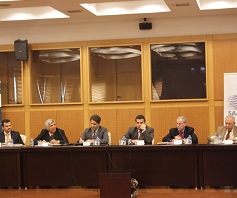
The Center for Middle Eastern Strategic Studies (ORSAM) and the Center for Strategic Research (SAM) organized a meeting on January 28th 2015, hosting Álvaro Vasconcelos, Associate Senior Research Fellow with the Arab Reform Initiative. Vasconcelos presented his report, “Scenarios for a Peace Mission for Syria”, which analyzes the current situation in war-ravaged Syria and examines several possible scenarios for a peacekeeping mission in the country, providing some recommendations to international actors, particularly the UN and the EU. The participants included ORSAM President Associate Professor Şaban Kardaş, Mr. Can Dizdar, Director General for Bilateral Political Affairs, Ambassador Mohamed El Fatah NACIRI, Head of Mission of the League of Arab States to Ankara, Randa Slim, Director of the Track II Dialogues initiative at The Middle East Institute, and Robert Stephen Ford, the United States Ambassador to Syria from 2010 to 2014, along with numerous researchers and diplomats. There was also an extended question and answer session where the several distinguished diplomats, academicians and senior civil servants attending the event could share their views on the presented report.
The meeting was moderated by ORSAM President, Associate Professor Şaban Kardaş and then began with Vasconcelos’s exposition of the key lines of his report, who first highlighted the complexity and fragmentation of the Syrian conflict, which reduces the probabilities of a peace deal coming from the victory of one of the parties. Given the international dimension of the war, one scenario for a peace deal would be an external settlement derived from an agreement between major global powers, mainly the United States and Russia. However, Vasconcelos argued that a regional solution promoted by key regional powers such as Turkey, Saudi Arabia and Iran, backed eventually at a global scale, was the most likely solution to the conflict. In any case, a comprehensive “two-tier” peace mission would be needed to address the humanitarian crisis, which should include both a peace-enforcement and a peace-keeping component. For the implementation of the mission, the commitment of NATO countries to form a stabilization force would be essential, as well as the participation of Arab countries and even emerging powers such as the BRICS countries at the peace-keeping level.
After the initial speech of Vasconcelos, there was a very diverse exchange of ideas with the other participants. Can Dizdar highlighted the relevance of the international dimension of the conflict and its connection with other current events; hence, a solution would need to address and balance conflicting issues at domestic, regional and global level. Later, Former US Ambassador to Damascus Robert Ford discussed the American policy toward the Syrian conflict, as well as his reflections on the report. Ambassador Mohamed El Fatah Naciri, pointed out the role of sectarian divisions in the conflict, which hinders the construction of a broad consensus among Arab League countries.
In his closing remarks, Mr. Vasconcelos thanked the rest of the participants and the audience for their useful insights on his report and reflected on the rising important role of ISIS. He argued that ISIS further complicates the conflict and underlines the need to provide a political solution, not only a military one, in order to isolate ISIS and reduce its international support.

23.06.2025
All Rights Reserved 2012 - 2026 | Orsam


 Google Calendar Add


