Filtre

Type the word you want to search for
4 minute reading time
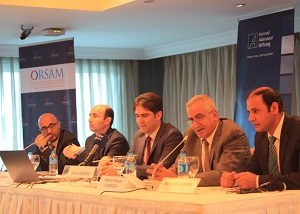
Center for Middle Eastern Strategic Studies (ORSAM) conducted a project with the support of Konrad Adenauer Stiftung Turkey Office. Within the framework of this project, a meeting to launch the report entitled “The Effects of the Syrian Crisis on the Neighboring Countries” was held at Ankara Swiss Hotel on 26 April 2016. A large audience participated in the meeting including bureaucrats, academicians, media members, foreign diplomats, research centers and representatives of nongovernmental organizations.
ORSAM President Şaban Kardaş and Turkey’s Representative of Konrad Adenauer Foundation Colin Dürkop delivered the opening speeches of the meeting. Following the opening speeches, former President of the National Coalition for Syrian Revolutionary and Opposition Forces and Member of Supreme Commission for Negotiations Khaled Khoja made a speech as the guest of honor. In his speech, Khoja indicated that Assad regime could continue its existence by purchasing time from the international community after the chemical attack in Gouta. Khoja stated that they witnessed a new axis of Iran and Russia in Syria and that this axis constituted a serious problem for the countries neighboring Syria. Khoja also mentioned that terrorism problem became an important issue with the disintegration of state structure and the melting borders in Syria and that existing approaches caused the continuity of this vicious cycle feeding on terror and dictatorship in the region, far from solving the problem. He indicated that was the reason why a more comprehensive and serious approach was needed with the positive and efficient participation of the countries in the region. Khoja underlined that they were in favor of a political solution as Syrian opposition, but the regime avoided from negotiating about the political transition.
After the speech of Khaled Khoja, the report was presented depending on the field work that ORSAM conducted in four countries neighboring Syria (Turkey, Iraq, Jordan and Lebanon). One of the authors of the report, Assoc. Prof. Dr. Ferhat Pirinççi made the presentation about the effects of the Syrian crisis on Iraq and Lebanon while ORSAM Researcher Oytun Orhan mentioned its effects on Jordan and Turkey. In the report, it was revealed from a comparative perspective what the Syrian civil war resulted in for four neighboring countries in terms of the political, economic, social, security and military effects and trends of radicalization, state structure, armament and basic services.
After the launching of the report, a panel entitled “The Effects of the Syrian Crisis on the Neighboring Countries” was moderated by ORSAM President Şaban Kardaş. In this session of the workshop, participants from Jordan, Lebanon, Iraq and Turkey made presentations which dealt with the effects of the Syrian crisis on their own country from various dimensions. Nasser Yassin from Issam Fares Institute under American University of Beirut made the first speech in the panel and talked about the effects of the Syrian crisis on Lebanon in his speech. Specialist at the Center for Strategic Studies under the University of Jordan Walid Al-Khatib took the floor later on. Khatib discussed the effects of the Syrian civil war on Jordan mostly from the perspective of Syrian refugees. The third speaker was the President of Al-Nahrain Center for Strategic Studies in Baghdad, Hamza Hassan Shareef who made a speech which largely supported the findings of the launched report about Iraq and talked about the effects of the crisis especially on the security of Iraq. Lastly, the President of the Diplomatic Academy of Turkey Ministry of Foreign Affairs Assoc. Prof. Dr. Mesut Özcan made a presentation about the effects of the Syrian crisis on Turkey. The meeting ended with the comments of the guests and the question answer session.

23.06.2025
All Rights Reserved 2012 - 2026 | Orsam


 Google Calendar Add


