
Search

Type the word you want to search for

Coordinatorships

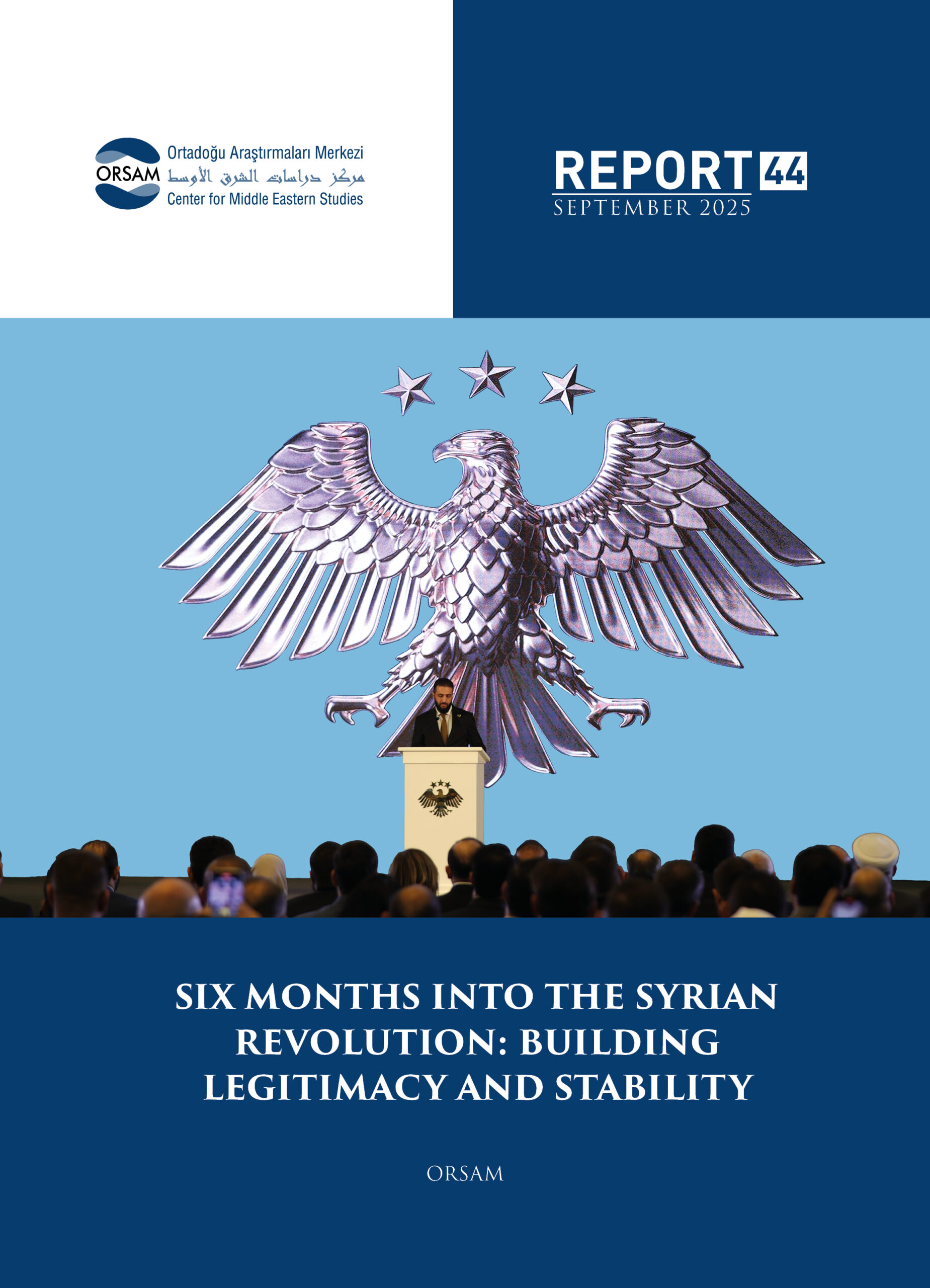
Six Months into the Syrian Revolution: Building Legitimacy and Stability

8 minute reading time | 01.09.2025

INTRODUCTION

PART I: LEGITIMACY AND STATE-BUILDING

  1. DOMESTIC POLITICS AND THE CONSTRUCTION OF NATIONAL LEGITIMACY
    • Inclusivity: The Cornerstone of Political Legitimacy
    • Unitary State: The Model for the Political System
    • The National Dialogue Conference: A Concrete Step Toward Building Legitimacy
    • The Constitutional Declaration: A Legal Framework for Legitimacy
    • Establishment of the Interim Government
    • Conclusion
  1. FOREIGN POLICY AND THE CONSTRUCTION OF INTERNATIONAL LEGITIMACY
    • Re-engagement with the Arab World
    • Strategic Partnership with Türkiye
    • Relations with the West and International Organizations
    • Conclusion

PART II: THE PURSUIT OF SECURITY AND STABILITY

  1. SECURITY STRATEGIES AFTER THE REVOLUTION
    • Formation of Military and Security Institutions
    • Combating the Remnants of the Assad Regime
    • Countering Weapons and Drug Trafficking
    • The Struggle Against ISIS/DAESH
    • Conclusion
  1. CHALLENGES TO SYRIA’S POLITICAL UNITY
    • The Uprising of Assad Loyalists
    • Rising Tensions with the SDF/YPG
    • Israel’s Intervention in Syria and the Druze
    • Conclusion

PART III: REBUILDING SYRIA’S ECONOMY

  1. PROSPECTS FOR ECONOMIC RECOVERY
    • The Economic Legacy of the Assad Regime
    • The Main Obstacles to Economic Recovery
    • The Economic Impact of Lifting Sanctions
    • Assessing the Possibility of Recovery
    • Conclusion

CONCLUSION

EXECUTIVE SUMMARY

  • The transitional period in Syria following the overthrow of the Ba’ath regime in December 2024 has been marked by key developments that reflect the new government’s domestic and foreign policy orientations, along with the fundamental challenges it faces.
  • Upon assuming power, the new administration under Ahmad al-Sharaa immediately embarked on a comprehensive legitimacy-building process designed to repair the political, social, and institutional damage inflicted by the war. This strategy was structured around four key pillars: restoring a unitary state, promoting social inclusivity, activating participatory mechanisms, and establishing legal safeguards through an interim constitution.
  • In the post-revolution period, inclusivity has become a defining pillar of the new administration’s political vision. This commitment is evident in its inclusive rhetoric, outreach to ethnic, religious, and sectarian minorities, attention to diversity in institutional representation, and the integration of the principle of equal citizenship into the interim constitution.
  • The al-Sharaa administration has outlined a political vision that prioritizes national unity as a safeguard against sectarian and ethnic fragmentation. This vision aims to centralize security and institutional structures domestically, while pursuing an independent and balanced course in foreign policy.
  • The National Dialogue Conference marked one of the most critical turning points in the new administration’s legitimacy-building process and stood as its most comprehensive attempt to establish political legitimacy on both institutional and normative grounds. The conference’s emphasis on inclusive representation, the broad scope of its thematic discussions, and the foundational nature of its decisions all reflected the administration’s effort to construct a governance framework rooted in public consent.
  • The government’s decision to launch a new constitution-making process reflects both an urgent need for legal restructuring and a strategic effort to strengthen social legitimacy. Indeed, the constitutional process serves as one of the primary platforms through which the new administration seeks to redefine itself as a legitimate, inclusive, and institutionalized political actor.
  • The formation of a pluralistic government in March, followed by the creation of the Supreme Committee for the People’s Assembly Elections in June, underscores the administration’s intent to establish a political order based on public consent. These steps reflect its broader aim of deriving legitimacy through a broad-based social consensus.
  • In its first six months, the foreign policy of the new government was shaped by the fragility of its political, economic, and military structures, the security imperatives of transition, and the dynamics of regional geopolitical competition. In this context, the administration adopted a pragmatic approach aimed at reintegration into the international community, normalization of regional relations, and the easing of economic sanctions.
  • Syria’s evolving national identity, emerging political and economic structures, and the ideological orientation of its new leadership have necessitated a recalibration of foreign policy. These factors have facilitated Syria’s pursuit of more cooperative relations with its neighbors, the wider region, and the international community—an orientation already evident in its diplomatic initiatives during the first half of 2025.
  • The new administration embraced a pragmatic, dynamic approach to diplomacy, marking a decisive departure from previous practices. Within six months, Syria emerged as a partner to both regional neighbors and global powers, achieving sanctions relief and gaining broader international support.
  • Al-Sharaa’s first trip abroad to Saudi Arabia, his attendance at the Arab League Summit, and his active diplomacy with Arab countries marked a major shift in Syria’s foreign policy. This move signals a break from the Iran-focused approach of the Assad era and a return to closer ties with the Arab world.
  • In parallel with its outreach to the Arab world, Syria has been cultivating a strategic partnership with Türkiye, centered on defense and security. Al-Sharaa’s three visits to Türkiye so far reflect the administration’s drive to strengthen and expand this relationship.
  • Syria’s contacts with the United States (U.S.) reflected its desire to reintegrate into the international system. Talks with the Trump administration produced agreements on combating DAESH, providing security guarantees for Israel, and curbing Iranian influence, leading ultimately to the lifting of U.S. sanctions. Engagements with European states and participation in international forums further underscored Syria’s commitment to cultivating constructive and balanced relationships with global actors in the new era.
  • The military and security institutions of the new state were built on the structures that had emerged in Idlib during the civil war, but they were reshaped through reforms and integration processes to meet the demands of the new period.
  • Remnants of the Assad regime represented the first major threat to internal security in post-revolution Syria. While the government largely managed this challenge through amnesty measures, reconciliation centers, and targeted military operations, the possibility of these groups re-emerging—particularly in coastal areas with potential external support—remains a long-term concern.
  • Efforts to combat drug and arms trafficking have focused on the western border with Lebanon, the southern border with Jordan, and the eastern border with Iraq. By contrast, the Turkish border has stood out for its relative stability, owing largely to Türkiye’s cross-border operations during the civil war and its effective control of the frontier.
  • ISIS/DAESH has shifted its strategy in Syria, increasingly targeting religious and sectarian minorities to exploit social fault lines and attract foreign fighters. Although DAESH activity sharply declined following the regime’s collapse, indicators suggest a gradual resurgence in the second half of 2025. The normalization of U.S.-Syrian relations has created a new dynamic, enabling Damascus to coordinate more closely with Washington in combating DAESH.
  • A central goal of the new government has been to restore political unity across Syria. Yet the presence of armed groups that reject central authority—and the conflicts they provoke—has triggered severe political, military, and humanitarian crises. The main obstacles to unity during the transitional period include uprisings by remnants of the Assad regime in coastal regions, the resistance of the Syrian Democratic Forces (SDF/YPG) to integrate with the central government, and Israel’s destabilizing interventions in the south.
  • The new government has pursued political negotiations aimed at disarming the SDF and integrating its forces into the central state apparatus. In March 2025, an agreement was signed outlining the reintegration of SDF-controlled areas into Syria in exchange for constitutional guarantees for the Kurdish community. However, the SDF has deliberately stalled implementation by insisting on maintaining its autonomous status. This stalemate generates significant uncertainty over the future of Damascus-SDF reconciliation and poses a major challenge to national unity in Syria.
  • In the post-Assad era, Israel has emerged as the most serious external threat to Syria’s territorial integrity. Through airstrikes and ground incursions, Israel has pursued a strategy of keeping Syria weak and fragmented. Curbing such interventionist policies is essential for Syria’s political unity and long-term stability.
  • The new government has inherited an economy in profound disarray. Years of civil war, compounded by international sanctions, have severely undermined infrastructure, state institutions, and human capital. These structural weaknesses are further exacerbated by persistent security challenges, social fragmentation, and constrained economic resources, all of which significantly impede prospects for a rapid and sustainable recovery.
  • By 2025, the lifting of international sanctions has reopened avenues for reconstruction and investment in Syria, presenting a major opportunity for economic recovery. Türkiye, Gulf states, and several European countries are preparing investment projects across key sectors, including infrastructure, energy, and construction. At the same time, the return of Syrians from the diaspora and their involvement in reconstruction efforts are gaining momentum.
  • The first six months of Syria under al-Sharaa’s leadership have signaled a promising start, inspiring cautious optimism for the post-conflict era. This transitional period has demonstrated tangible potential for progress, indicating that the country can be reconstructed on the foundations of national unity, political legitimacy, and regional integration.
Reports

Headings

Share this post
Print

Other Publications