Filtre
Type the word you want to search for
6 minute reading time
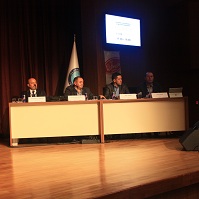
7th Uludağ Conference on International Relations “In Search of a New Order in International System” took place on 21-22 October 2015 and ORSAM session was held on the second day of the conference. ORSAM advisor Prof. Dr. Harun Öztürkler, ORSAM guest researcher Watiq El-Sadoon and ORSAM researchers Oytun Orhan and Bilgay Duman took part as speakers.
Being the moderator of the session and the first to take the floor, Harun Öztürkler made a presentation entitled “The Impacts of the Nuclear Agreement on Turkey-Iran Economic Relations”. Öztürkler stated in his presentation that the main expectation about international economic consequences from the agreement that was signed by Iran and P5+1, is that the Iranian economy -which has been blasted by the international economic sanctions- will enter into the rehabilitation process and its way to reconnect to the global economy will be paved. Öztürkler posited that as a result of lifting energy resources exports sanctions, accessing to financial markets and especially expected substantial increase in the foreign investment will increase economic growth and income level from the beginning of 2016 which are the most important aspects of the agreement. Öztürkler stated that Iran with its 400 billion dollars GDP is second largest economy after Saudi Arabia in the Middle East and North Africa (MENA) region, in this sense he emphasized that Iran is one of the most important economic partner of Turkey. He added that Iran has made substantial effort to improve economic relations with Turkey in order to curb the negative effects of the international economic sanctions, thus, he underlined that in which direction will the nuclear agreement affect Turkey and Iran’s economic relations has become an important economic research question.
Watiq El-Sadoon took the floor after Öztürkler. He made a presentation about the impact of PKK’s presence in Iraq on Turkey-Iraq relations. He stated that PKK as a terrorist organization has always been a problem in terms of Turkey-Iraq relations. Sadoon posited that as a result of the improving relations of Turkey with Iraqi central government since 2005 Turkey could make air and ground operations in Northern Iraq and he attracted attention to the establishment of the “High Level Strategic Cooperation Council” with Iraq in 2008 and signing in this context of 48 Memoranda of Understanding. Sadoon stated that Turkey-Iraq relations peaked in this period and also added that Turkey’s cross border operations in this region are not welcomed at the regional and international arena. Sadoon said that because of regional developments, Turkey’s good relations with Iraqi Kurdistan Regional Government, Iraqi central government’s position Iraq-Turkey relations started to deteriorate since 2005 and added that Nuri El-Maliki government in Iraq uses PKK as a tool. Sadoon stated that as the Syrian crisis erupted, Turkey and Iraq took different positions, and therefore, after the crisis, tension increased between the two. Sadoon stated that security perceptions have changed after ISIS presence in Syria and Iraq and in this sense he added that PKK is being used in the struggle against ISIS and getting advantage from its military power. Sadoon emphasized that in the case that Iraq-Turkey relations get better, PKK will no longer be a factor in their relationship.
After Sadoon, Bilgay Duman made his presentation titled “Turkey’s Iraq Policy after 2003”. Duman analyzed Turkey’s policy by dividing it into four periods. Duman categorized these periods as; 2003-2005: Low profile politics period, 2005-2010: Center-oriented politics period, 2010-2014: Local-oriented politics period, 2014 and after: New period in relations. Duman said that after Turkish parliament rejection of the resolution authorizing the deployment of US forces to Turkey on March 1, 2003, Turkey’s influence on Iraq in post-US intervention was limited. Because of this reason, Iraq relations was in a low profile until 2005, he added that because of the need to integrate Sunnis into political process and regional developments Turkey was back in the equation. Duman said that in this process, Turkey developed good relations with Iraqi central government and relations between Iraq and Turkey peaked in 2009. However, after the 2010 elections, Nuri El-Maliki became the president and relations started to deteriorate. Duman stated that since the developments in Syria started in 2011, tensions between the two countries gradually increased, because Turkey and Iraq took different positions and underlined that with the energy and trade agreements signed with the Iraqi Kurdish Regional Government, relations with the Iraqi central government almost hit the breaking point. Duman said that, after Nuri El-Maliki gave up on his persistence in presidency and resigned from 3rd term presidency and Haydar El-Abadi formed a new government the relations started to show tendency of recovery and concluded his words by stating there is need for Turkey in Iraq with the struggle against ISIS.
Lastly, Oytun Orhan took the floor. He made a presentation on “Syrian Crisis and Turkey” and made a historical categorization of the Syrian crisis and showed the different political approaches of Turkey to Syria at different times of history. Orhan stated that from March to September 2011, a period of “engagement” was experienced between Turkey and Syria when Turkey tried to operate as shield between the majority of the international community -which has a harsh attitude towards Assad- and the Syrian regime. Orhan said that when it is understood that the regime will only use more force to suppress the uprisings, Turkey gave up this policy and since September 2011, Turkey implemented the policy of isolation and pressure. Orhan stated that parallel with the increase of use of force by the Syrian regime, Turkey started to actively support the Syrian opposition since 2012. Orhan said that this situation points out a new phase in Turkey’s policy on Syrian crisis and added that Turkey’s support to opposition gradually increased. Orhan posited that a new phase for Turkey’s Syria policy will be about adapting its Syria policy to the new reality on the field and added that due to the prolonged civil war, the threats originating from the Syrian territories diversified. The session ended with the questions and answers period.

23.06.2025
All Rights Reserved 2012 - 2026 | Orsam


 Google Calendar Add


