Filtre
Type the word you want to search for
4 minute reading time
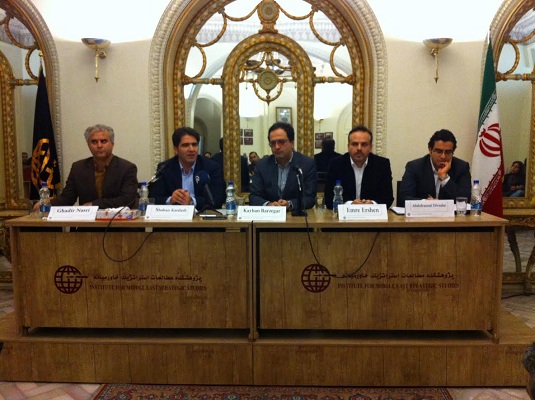
ORSAM hosted the delegation of the Center for Strategic Studies under the President of the Republic of Azerbaijan (SAM) on November 19, 2015. The delegation led by SAM Director Dr. Farhad Memmedov included Dr. Javid Valiyev, Elmar Huseynov, Dr. Musa Qasımlı. ORSAM delegation was led by ORSAM Director Assoc. Prof. Dr. Şaban Kardaş and included ORSAM researchers Oytun Orhan and Bilgay Duman, ORSAM advisors Prof. Dr. Harun Öztürkler, Assist. Prof. Dr. Bayram Sinkaya and Dr. Pınar Arıkan.
The meeting started with the introduction of the institutions by the directors. The theme of the meeting was the developments in the Middle East and the Syria crisis. Main issues discussed within the context of Syria crisis were ISIS terrorist organization, Kurdish politics, role played by the USA and Russia in the region, Iranian policy, Iraq’s situation, and the impact of the developments in Syria on Turkey. Azerbaijan delegation’s question on the opposition groups in Syria and Syrian territorial integrity was replied by ORSAM researcher OytunOrhan who stated that there was no change in the fragmented structure of Syrian regions divided between different opposition groups. Orhan continued that Syria was under the control of four different groups, which were mainly ISIS, Syrian opposition including the Salafi groups, PYD and Assad regime. He stated that the US actions helped especially PYD among these groups.He further argued that the intentions of the US were not clear and one of its possible intentions could be to create a Kurdish region that would have a reach to the sea. According to Orhan, the Syrian Democratic Forces that was formed as a US initiative included Arab, Kurdish, and Turkmen elements, which meant that the US aimed at preserving the current balance of territory in Syria for the time being. The Russian intervention, however, helped to Assad regime on the ground but not to the Kurds apart from political support.
Azerbaijan SAM Director Memmedov mentioned that conditions were available for the establishment of a homogenous state structure neighboring Turkey that would unite all the Kurds. Against this view, ORSAM researcher BilgayDumanargued that this scenario was not possible especially due to the different views among the Iraqi Kurds. Duman stated that PUK and KDP, the two parties that shared the government in the Kurdish Regional Government after 2003, had still not been able to ensure administrative unity, that there had still been two Peshmerga Ministries and Finance Ministries,and that the problems between the central government and the Kurdish Regional Government had still not been resolved. He further stated that there was no homogeneity within the Kurdish Regional Government regarding the language spoken and there was no unity in language. Although the idea of an independent state was alive among the Iraqi Kurds, the general view was that the regional government had still not been ready for independence yet. Therefore, according to Duman, even as the Iraqi Kurds were not ready for independence, it was not possible that all the Kurds in the region would be united under a single independent state.
The meeting continued with the discussion on the Iranian role in the regional developments. The discussion started with the US-Iran rapprochement after the nuclear deal and scenarios on how Iran would use the money that would enter into the country after the release of Iranian frozen assets in the foreign banks. Azerbaijan SAM Director Memmedovargued that Iran had two options to use this money, whichwere either transferring it to the domestic economic activity or to its expansionist activities in the Middle East. ORSAM advisor Pınar Arıkan stated that Iran would try to use both options, and BayramSinkaya argued that there were different power centers inside Iran and that there was not a single Iran in policy-making and implementation.Memmedov stated that the expansionist attitude of Iran served to establish a Shi’i state in the lands starting from Iraq to the west until the Mediterranean. After JavidValiyev’s argument that Iran’s economy that had not collapsed since thirty-five years in the face of sanctions would become much stronger after the solution of the nuclear issue, ORSAM advisor HarunÖztürkler commented on the impact of the lifting of sanctions on Iranian economy and the burden of the Syrian crisis on Turkish economy. The meeting ended with exchange of views on the possibility of an end to the Syrian crisis in the short and medium terms.

23.06.2025
All Rights Reserved 2012 - 2026 | Orsam


 Google Calendar Add


