Filtre

Type the word you want to search for
3 minute reading time
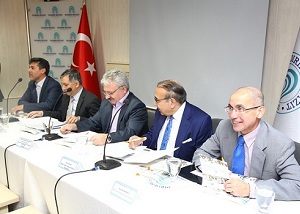
ORSAM and YBÜ/ULISA Center organized a joint panel, titled ‘Iran and Its Neighbors: Opportunities and Challenges,’ on March 31st, 2016. The panelists were Jafar Haghpanah from University of Tehran/Iran, Bayram Sinkaya from Yıldırım Beyazıt University/Turkey, Gawdat Bahgat and Ali Jalali from NESA Center of National Defense University/USA. The moderator of the panel was Mustafa S. Bilgin from Yıldırım Beyazıt University.
The first speaker, Haghpanah, elaborated the factors affecting Iranian foreign policy towards its neighbors. He mentioned strategic culture of Iran, Iranian identity, idea of sovereignty, dynamism and chaos in the region as the reasons for Iran’s active foreign policy towards its neighbors. The second speaker, Ali Jalali, talked relations between Afghanistan and Iran. He emphasized that although Afghanistan and Iran were geographically located in the Iranian plateau and thus, had the same culture, language, and history, bilateral relations of Afghanistan and Iran shaped by their relations with third parties. Gawdat Bahgat, the third speaker, talked the relations between Iran and the US after mentioning the Sunni-Shia divide and regional polarizations. He argued while Sunni-Shia divide was real, it was not the whole story since there were no monolithic Sunni and Shia blocs and both Iran and Saudi Arabia were pursuing their own national interest to be accepted as the major regional powers.As to the Iran-US relations, Bahgat emphasized the fact that both the US and Iran had moderate presidents at the same time. Being a very rare happening in the history of the bilateral relations of the two, he added, Iran had to lobby the administration and the Congress where she had very few friends. Baghat also mentioned the importance of non-zero-sum nature in the bilateral relations both between Iran and the US and between the Middle Eastern states. Last speaker, Bayram Sinkaya, talked Turkey-Iran relations after the nuclear deal.In attempt to explain the betterment of relations after Turkey’s cautious approach to the nuclear deal, Sinkaya mentioned the compartmentalization model in Iran-Turkey relations in the last ten years. He argued that the two states had divergent opinions in their regional policy for the last ten years, but they managed to sustain good bilateral relations. After the Arab spring, Turkey’s increasing engagement with the region turned the divergent opinions into conflict of interests. However, Davutoğlu’s last visit to Iran proved that two countries turned back to the compartmentalization model of bilateral relations since divergent regional policies did not constitute structural problems in bilateral relations, and Turkey was trying balance its strategic concerns and economic interests regarding the Iranian market that became more important for Turkey after the nuclear deal.
The panel ended with the Q&A session.

23.06.2025
All Rights Reserved 2012 - 2026 | Orsam


 Google Calendar Add


