Filtre

Type the word you want to search for
5 minute reading time
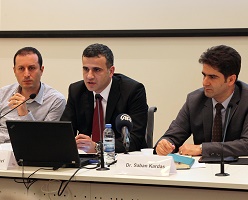
ORSAM and Issam Fares Institute of the American University of Beirut organized a panel entitled “The Impact of the Syrian Crisis on Neighboring Countries” at the auditorium of Issam Fares Institute inside the American University of Beirut Campus on March 2nd, 2015.
ORSAM President Assoc. Prof. Şaban Kardaş, Faculty Member of Uludağ University and ORSAM Advisor Assoc. Prof. Ferhat Pirinççi and ORSAM Researcher Oytun Orhan took part as speakers of the panel in which the Vice President of Issam Fares Institute Dr. Rayan El Amine was the moderator. Following the opening speech of Rayan El Amine, the first speech was of ORSAM President Şaban Kardaş. Kardaş talked over the main factors in Turkish foreign policy constitution. In this context, he explained how Turkey has adopted its policy about the Syrian Crisis and refugee flow. He pointed out that Turkey supports the political formula for Syria that was concretized at Geneva-I Conference. By emphasizing the importance of the political formula, he argued that this formula would force Assad regime to a political transition for a more democratic governing. He expressed that Turkey supports the moderate opponents in Syria and believes that these groups may be an alternative to governing in Syria. Kardaş also stated that radical groups in Syria are serious threats to Turkey especially in the border region.
The second speech titled “The Impact of the Crisis on Iraq: ISIS and its Beyond” was presented by Ferhat Pirinççi. Pirinççi discussed the effect of the Syrian Crisis on Iraq in several aspects. Firstly, Pirinççi talked about the effect of the crisis in humanitarian dimension and indicated that even the number of the refugees who fled to Iraq is less than the refugees who went to other neighboring countries, there are many internally displaced people in Iraq. He stated that there are about 245 thousand Syrian refugees in Iraq; however, 2.2 million Iraqi citizens had to leave their houses for moving in safer places. He emphasized that the second impact of the crisis is destabilizing of state structure and that the political life’s getting more problematical. In this context, he pointed out that the processes of forming a government and electing a president are getting harder and sometimes policies to “avenge” are implemented. Pirinççi discussed the social and economic impacts of the crisis and drew attention to the structural problems of Iraq by comparing Iraqi economy with Turkish economy. He indicated that when looking at the social impact of the crisis, the change of the demographical structure is taking place and forced immigration is adopted as a policy by different groups. Pirinççi also related ISIS’s seizing control of some regions to support of the local community in military aspects. He stated that the reason behind this situation is that the majority of local community see ISIS as a power who relieved these people from Iraqi Army which was seen as pressure tool of Maliki. Lastly, Pirinççi discussed the impacts of the crisis on the international and regional alliances of Iraq.
The third speaker Oytun Orhan gave a presentation titled “Humanitarian Aspect of the Syrian Crisis: Refugee Problem.” In his presentation, Orhan addressed impacts of Syrian refugees in Turkey, Lebanon, Jordan, and Iraq. After sharing official statistics about Syrian refugees, Orhan emphasized that actual numbers are much higher with unrecorded Syrians. Orhan mentioned about problems between local people and Syrians. Orhan explained that despite the high level of refugee flow, there hasn’t been a major social explosion or tension, because societies have developed a brake mechanism between themselves. Supporting the notion that refugee crisis has positive impacts right alongside with negative ones, Orhan indicated that Syrians contributed economically to countries they settled. He pointed out the tension takes place due to different lifestyles, languages and cultures, changes in demographic structure. He stated that reactions against Syrians’ being recruited as cheap labor force and taking job opportunities away from local people and complaints about raise in crime rate do not overlap with reality and aspect of perception is strong.
Orhan emphasized that regarding security aspect of the issue, it becomes common concern that local people feel themselves open to terrorist attack. Mentioning about majority of Syrian refugees’ being Sunni-Arab has created tension in some areas with fragile demographic structure, he emphasized this situation is obvious for Lebanon. Addressing burdens imposed by Syrians on basic services such as education, health and municipal works, Orhan emphasized that allocation of Syrians in the country should be more balanced and municipalities which host more Syrians should be supported more. At the end of his speech, Orhan addressed fundamental distinction of approach between Turkey and other countries hosting Syrian refugees. Accordingly, while Turkey accepts refugee crisis as a reality, which will continue for a long time, and tries to turn it into an opportunity, other countries approach to the issue of Syrians’ being permanent as a taboo. Therefore, Turkey pursues refugee policy in line with integration of Syrians.
Panel was over with the answers to the questions regarding the impacts of the Syrian Crisis to intraregional trade and Sunni-Shia conflict, the role of the US on the crisis, Turkey’s support to moderate opponents, and the efficiency of Turkey’s policy on Syria Crisis.
After the panel, a closed workshop was conducted with the participation of ORSAM team, the researchers of Issam Fares Institute and faculty members of the American University of Beirut. Turkey’s perspective about the political transition process of the Middle East, Turkey’s Middle East policy, and the challenges which Turkey faces were discussed by ORSAM. Afterwards, the Lebanese participants talked about the impacts of the crisis on Lebanon. The workshop was over with a Q&A session.

23.06.2025
All Rights Reserved 2012 - 2026 | Orsam


 Google Calendar Add


