Filtre

Type the word you want to search for
8 minute reading time
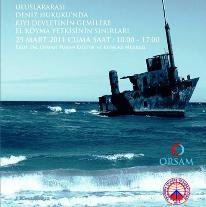
ORSAM (Center for Middle Eastern Strategic Studies), held a symposium on “Limits of Power in Distraining on Ships By a Coast State on the International Maritime Law” in cooperation with Karadeniz Technical University (KTU) and Trabzon Chamber of Commerce and Industry, in Trabzon, on March 25-26, 2011. In the symposium, the following topics were discussed: “The Black Sea Maritime Security”, “The Ship Traffic Lanes in the Black Sea”, “The Geopolitics and Security of the Black Sea”, “The Scope of The States’ Power of Intervention on Ships in Open Seas in International Law”, “The Power of Distraining on Ships by States in the Point of View of Property Right Within The Framework of European Convention on Human Rights”, and “The Sea Border Agreements of Turkey and The Present Situation.”
In the panel discussion, firstly Hasan Kanbolat, director of ORSAM, took the floor and stated that Georgia distrained on approximately one hundred Turkish ships including the fishing boats in last twenty years. Kanbolat pointed out that he believed the problems would be solved in a friendly way. He said: “We believe that the freedom of navigation and liberty of commerce are essential in the International Maritime Law. Democracy in the Black Sea is essential. We are already here for these efforts. We observe that Georgia distrained on almost one hundred Turkish and other foreign national ships including fishing boats in last twenty years; more than forty ships between 1999 and 2003, twenty-two ships between 2004 and 2006. Are the problems being solved? –Yes, they are being solved quickly. It is observed that Turkey and Georgia formed a working group; these problems are discussed and our ships are released through the goodwill of Georgia. At present, we have a ship in Georgia: Afrostar. It is used as a military training ship. We hope this ship will also be released immediately. We all want the unity of Black Sea; Turkey does, Georgia does, and our other neighbours, Russian Federation and the West want it as well. It is necessary that the Black Sea become more free in the transport of persons and goods for its stability. The Black Sea has to be unifying instead of being discriminative. In this region, we have close relations with our border neighbour Georgia. Our land border is vanishing day by day and visa requirements are lifted. The preparations of crossing the border through only showing the identity card have been completed for the first time with Georgia, from now on, we will put it into practice. When we look at the airspace boundry, there are two examples in the world: Geneva and Batumi. Batumi is used mutually, as a result of that our airspace boundry is vanishing as well. We want the friendship by land and by air to be by sea, too. Our sea border should vanish as well. We would like to converge on “the sea” and we aim that anybody will not intervene in anyone and everybody will know his place. It is important that we accept these problems as our burden and later on disburden by means of discussing our problems within family. Let’s transform Black Sea into a sea of democracy and freedom. The Georgians has a proverb, which is my favorite: “Your neighbor is always better than a far-away relative”. We are both neighbours and relatives. Consequently I believe that we will overcome these problems.”
“We understood the problem very well after we were exposed to it”
Suat Hacısalihoğlu, Chairman of Trabzon Chamber of Commerce and Industry emphasized that the symposium was very important since it brought up the conditions, which they suffered, on the international agenda. Hacısalihoğlu stated that he believed all concerned parties would show sensitivity on the issue and he added: “In the past years, the infringements of the Maritime Law occurred in west side of the Black Sea, but we assumed that it would not affect us because we were far-away. Yet, we understood very well after we were exposed to it. Especially, when we take into consideration the disturbance and loss of physical resources, we realized how we had been affected. It is the mutual respect of concerned parties in the Maritime Law that matters. We will have pecuniary loss and intangible damages through the thought that we will have troubles in our future seeing each other as “enemies” without this respect. Unfortunately the Black Sea, which we are willing to see especially as a shorefront, is not in the form we have dreamed of.”
Hacısalihoğlu stated that the problems in Black Sea affect not only the concerned countries, but also the third countries. “The problem with Georgia is based on the issues of Georgia between Russian Federation and Abkhazia and effect of commerce that occurs between Turkey and these countries. In other words, Turkey would like to improve the trade relations with neighbours in Black Sea but Turkey also causes us to see the issues between other states as “problems”. Actually, we do not have any trouble with Georgia. We have blood bonds and neighbourhood relations with Georgia. In the same way, we have similar relations with Russian Federation and Abkhazia. It is shaping of our future by means of the mutual respect, knowing our place, and staying away from unlawful issues that matters. Here, the trade is effective, otherwise if in this region, the agreements between neighbour states in scope of the Maritime Law surpass the international law, this may be a “casus belli” but, it is not like that in trade. Here it is our tradesmen and our ships that get damaged. We aim that the trade is improved in this basin and the welfare level rises as long as these unlawful incidents are precluded and the concerned parties do what they are supposed to.” he said.
“The losses of our ship-owners and sailors were not compensated”
Tamer Kıran, board member in Chamber of Maritime Trade, stated that the distraint on ships by coast states is based on three reasons as a result of political, economic and port controlling and especially in recent years, the political distraint on ships occurred in Georgia.
He said: “You know the Turkish flagged ships or foreign national flagged ships, but have Turkish owners, were detained and kept with all their crew for a long time on charges of having illegal shipment to Abkhazia while they were navigating in international waters in the Black Sea. The financial and emotional losses of our ship-owners and sailors were not compensated in meantime even though the problem is solved through long diplomatic initiatives.” Kıran also uttered that the distraints were made by the states, which have a coast by the sea or the ocean, due to economic reasons and the unauthorized use of the natural marine resources, on which these states stake out a claim in terms of international law. “The best example is the fishing boats were detained on charges of fishing in the territorial waters of a country. The results of his kind of distraints are the same with the unjust treatment that occurred because of political reasons which I mentioned earlier. The distraint in consequence of port controlling is the most common reason. The fact that the port state supervisor sometimes becomes so sensible, but sometimes can perform some nonobjective applications as well, is the reason, which calls out the commercial barriers. Again, by this unit, the ships can be detained on charges of polluting the environment even they are at international waters through heavy fine and the sailormen can be even sentenced to imprisonment.” he said.
After the speeches, the following presentations were made by the panelists- ““The limits of power in distraining on ships by a coast state on the international law of the sea” by Dr. Jale Nur Ece, and “The Legal Dimension of The coast state’s power upon distraining on ships” by Attorney Aslıhan Erbaş Açıkel.
In conclusion of the symposium it is indicated that:
-The coast states and flag states is to abide by the international agreements and regulations,
-It is necessary to assess the negative behaviours against the ship’s captain and the crew in terms of human rights during distraining on ships,
-The imprisonment of the ship’s captain and the crew can be served as long as it is based on legal basis,
-The Port state, which makes an arrest, is to precisely carry out the obligatory principle that the AIS device be kept on within the scope of IMO rules,
-In case the coast state distrains on the ship, they have to transmit the flag state all the available informations and documents in advance, distraining on ships illegitimately will endanger the security of Black Sea, the trade, the economy and the relations of six countries that have a coast on Black Sea,
-Georgia broke the terms of the International Maritime Law and the European Convention on Human Rights by means of distraining on ships in Black Sea,
-The marine accidents, likely to be under and after distraining on ships, may cause environmental pollution and it may have long-term and dangerous adverse effects on ecosystem in an inland sea, such as the Black Sea,
-It is necessary for Black Sea to maintain being LAKE OF PEACE, with six coast countries and stakeholders, same as before.
This is released to the public by the spokesmen and the participants as a final declaration.

23.06.2025
All Rights Reserved 2012 - 2026 | Orsam


 Google Calendar Add


