Filtre

Type the word you want to search for
14 minute reading time
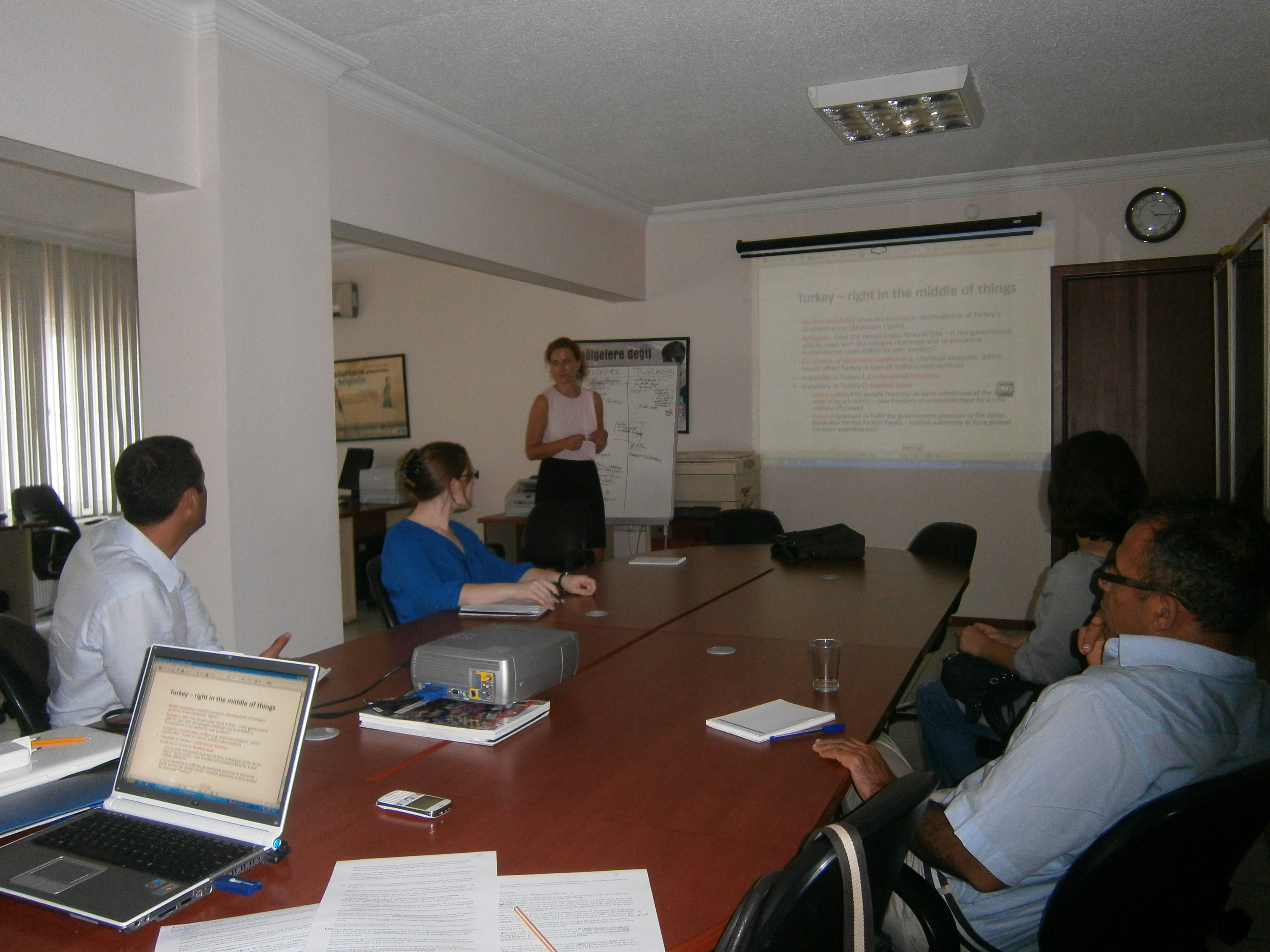
On July 3, 2012 Friday ORSAM researchers organized a round table discussion titled “On the sidelines – What Syria’s neighbors (should) prepare themselves for in the post-Assad Era” in chairmanship of Visiting Researcher Magdalena Kirchner, former head of the Working Group “Conflicts in the Middle East and Maghreb” at the Heidelberg Institute for International Conflict Research (HIIK) and PhD candidate at Heidelberg University’s Department of Political Science, at ORSAM. In this round table, the participants wanted to discuss and address the challenges and strategies of Syria’s neighbors Lebanon, Israel, Iraq, and Turkey in the course of the uprising in Syria. In addition to ORSAM Middle East Researcher OytunOrhan and ORSAM Middle East Research Assistant SelenTonkuş, Dr. Sardar Aziz from the Department of Government at the University College Cork in Ireland, who is also a Columnist for the nonpartisan weekly newspaper “Awene” published in the Kurdistan Region of Iraq, currently a Visiting Researcher at ORSAM participated in the discussion.
The meeting started with the introduction speech of Oytun Orhan addressing the question “why is Syria important for its neighbors?”.
OytunOrhan said that the process in Syria has been going on for one and a half years mainly because Syria differs significantly from the other regional countries that recently experienced regime change in terms of societal, political and security structures.
Mr. Orhan pointed out already in the beginning that, as Syria is located geographically in the heart of the Middle East, it is a vital country concerning nearly all regional issues. In some of these, Syria evenholds a central position(such as the Arab-Israeli conflict), whereas it has an indirect hand in others, such asthe rivalry between Israel and Iran, the Iranian nuclear issue, international terrorism, andthe Sunni-Shia sectarian conflict, which worsenedsignificantly after the 2003 invasion of Iraq. Therefore,Mr. Orhan concluded that because of these complex links between Syria and numerous Middle East issues, regime change in Syria could not be as easy as inother countries like for example Libya.
After setting the centrality of Syria in the region as the main reason of the longevity of the Syrian crisis, ORSAM Middle East Researcher OytunOrhan moved on to clarify the importance of the Syrian crisis for its smallest neighbor, Lebanon. Mr. Orhan said that Syria is the most crucial regional country, which has the capacity to affect Lebanese political system. He emphasized that in historical, geographical, societal and economic terms, Lebanon has obviously strong ties to Syria, which could even be called a detached part of Syria. Mr. Orhan maintained that until 2005, Damascus was almost directly governing Lebanon, i.e. governmental positions in Lebanon were not elected by the people or democratic institutions, but rather appointed by Syria. OytunOrhan said that Syria has significant leverage over Lebanon even after 2005, which was illustrated by Hezbollah’s toppling of the government in 2009, which could not have been possible otherwise.
Concerning Iraq, Mr. Orhan said that Syria was harshly criticized especially by the United Statesafter 2003, as the country that sponsors anti-American forces and terrorist activities in Iraq, allows resistance forces to infiltrate into Iraqi territory from the Syrian border, and hosts ex-Baathists. Thus, also in this case, Syria’s policy is vital for the stability its neighbor.
As for the Sunni-Shia conflict in the Middle East, Mr. Orhan stated that Syria is one of the most important chain links in the so called Shia Crescent – ranging from Bahrain to Lebanon. Mr. Orhan indicated that the alignment between the Alawite regime in Syria and Shi’iteIran as well as Hezbollah includes several strategic issues related to regional politics, as well as ideological and religious factors. Mr. Orhan expressed that in case of a new Syria dominated by Sunni Arabs, the balance of power in the region between the Sunni and Shia bloc, will shift in favor of the Sunnis. Thus he said Syria also holds a vital position regarding the future of the Sunni-Shia rivalry in the region.
Oytun Orhanalso addressed the Iran-Israeli rivalry and assumed that if a post-Assad Syria will leaveits strategic alliance with Iran, this will weaken Tehran and enhance Israel’s position at its expense This, according to Mr. Orhan,is the reason why Iran has been trying its best to led Assad regime survive.
Finally, Mr. Orhan added the effective usage of terrorism, as well as relations with non-state actors and proxies as foreign policy toolsthat have enhanced Syria’s position in the region despite the fact that it posesses only a few material foreign policy resources. ORSAM Middle East Researcher OytunOrhan concluded that all these factors made a quick regime change in Syria much more difficult in comparison to other Middle Eastern states.
Following Oytun Orhan’s opening remarks, Magdalena Kirchner compared Israel and Turkey’s outlook to the Syrian Crisis in general and to recent developments in particular. Both country’s exceed Syria in military, political and economic power by far and did not perceive Assad Syria as a substantial threat to their security. Since 1974, the Syrian-Israeli border has been one of the quietest in the region and after the 1998 Adana Agreement Syrian-Turkish relations had improved dramatically. Ms. Kirchner pointed out that the recent crisis and especially its international spillover effects changed this beneficial situation and are likely to heavily influence Israel and Turkey’s security calculations in the next months.
In contrast to Turkey, which sided with the opposition at a comparatively early stage of the uprising, Israel remained literally on the sidelines of the conflict and even recent remarks by President Shimon Perez, that he hopes “the rebels will win” were not followed by any substantial acts of assistance (at least not publicly). Magdalena Kirchnerstressed the local limitations of Israeli interference in the conflict, given the decades of hostile relations and resentment of Israel even by oppositional forces.She further discussed the general Israeli security outlook to the region, which has dramatically changed in the past two years and triggered also some changes in Israel’s security and especially alignment policy.
Despite their different approaches to the crisis in Syria, there are four main concerns that Israel and Turkey share regarding its transnational spillover effects. The most immediate transnational challenge is the refugee crisis, which hit Turkey, together with Lebanon, Jordan, and Iraq, especially hard as more than 40,000 Syrians fled to north in the last year. Recent events in refugee camps and complaints of overstrained authoritiespressure the Turkish government into quicker results to establish conditions for their return. On the other hand, Israel’s border is still closed, yet given the relatively calm situation in the predominantly Druze areas, pressure on Tel Aviv to open it remains also low.
For the same reasons, Magdalena Kirchner sawIsrael (for now) as less threatened by border insecurity than Turkey, whose Southeastern region’s economic and political improvementmight be reduced significantly. According to Ms. Kirchner, both countries fear the destabilizing consequences of declining state power in Syriafor their border areas, particularly in Lebanon and Northern Syria, when the central authoritycannot prevent anti-Israeli and anti-Turkish militants from operating against them. Recent reports over the chance that Syria’s stockpile of chemical weapons might fall into the hand of terrorists further increased these concerns.
Concerning the future foreign policy of the Syrian (non-Assad) government, Ms. Kirchner was reluctant to predict specific developments and actions, yet stated that both the Cold War with Israel as well as good relations with Turkey (at least initially) are likely to continue after the crisis. As any government in post-Assad Syria will have to deal with major domestic political and economic challenges, big foreign policy shifts, except for a closer alignment with the West and a deterioration of Syrian-Iranian relations, are not expected.
Magdalena Kirchner concluded by examining both the spillover effects in ongoing conflicts in neighboring states Israel and Turkey. In the case of the first, the indecisive position and internal frictionamong the Palestinian leaders have impeded a spillover into a third Intifada. Although it is likely that Hamas, who turned away from Assad in the past months and left Syria, will realign with a government that is dominated by Sunni Arab – and especially Muslimbrothers – it remains uncertain, whether the new rulers in Damascus will encourage them to struggle or to settle. Thereafter, Ms. Kirchner opened the discussion by asking her fellow discussants about the domestic repercussions of the crisis on Turkey, especially regarding the Kurdish issue. She concluded by suggesting that the Syrian crisis will have both effects on the military as well as the political dimension of Turkey’s unsettled conflict with its Kurdish population and militant organizations like the PKK.
In the next section, ORSAM Middle East Research Assistant Selen Tonkuş addressed the effects of the Syrian Crisis on Iraq and said that the main reason why different groups reacteddifferently to the uprising were different interests, different threat perceptions and calculations and external pressures on them. Whereas thepredominantly Shia government in Baghdad showed its sympathy to the Alawite regime, most Sunnis sided with the Sunni opposition and the Kurds supported regime change from the beginning, initially by supporting the Kurdish opposition, later by encouraging the Syrian Kurds to cooperate with the mainstream opposition.
Firstly,Selen Tonkuş asserted thatthese reactions imply a link between the Iraqi factions’ perspective on Syria and the Sunni-Shia rivalry inside Iraq, which reemerged after the U.S.troops’recent withdrawal. Although its close relation to Iran is one of the main reasons for the government to support Bashar Assad, the Syrian crisis posesnevertheless some real and independent threats to it. Among these, the most crucial is a spillover of violence and sectarian conflict into Iraq, triggering its partition, a scenario which already seems highly likely given last year’s developments. As the most significant regional Jihadist presence lies across the Syrian border in Iraq, Ms. Tonkuş assumed that if a Sunni extremist regime should come to power in Syria, Iraq’s stability will be threatened by a possible Jihadist revival. Therefore, the Iraqi government stood against any foreign interference.
After having discussed the central government’s perspective, Ms. Tonkuş moved onto the position of the Kurdistan Regional Government (KRG).
According to her, the Iraqi Kurdish leadership initially refrained from supporting the Syrian uprising because of the historical ties of both KDP and PUK with Damascus, but later decided to support regime change and especially the Kurdish opposition in Syria as they wish to shape the course of Syrian Kurdish nationalism. Another crucial factor, which affected this decision, was the fact that the PYD had becomemore active in Syria in the last months and that KRG President Massoud Barzani wanted to appease Turkey by controlling PYD activity there. Despite the pro-change attitude of the KRG, Selen Tonkuş stressed that most Iraqi Kurds remain skeptical of the post-Assad period, since they are afraid of a Syrian government dominated by the Muslim Brothers and fear a spillover of political Islam into their region, a major pointgiven the already increasing scope of the Islamist parties. Additionally, such a scenario might also jeopardize the Kurdish interests regarding their disputes with Sunnis Arabs in Iraq.
Ms. Tonkuş emphasized the fact that all of these considerations were heavily affected by the bombings in Damascus on July 18. According to her, the first direct effect of theSyrian crisis in Iraq might be the 23 July attacks, which could indicate that the prolonged Syrian crisis deepened the divisions in a way that mightweaken the administrative strength of Iraq and increase the strength of Al Qaida and other Sunni militants. Only four days later, also Baghdad-Erbil relations were directly affected by the Syrian crisis, when Kurdish Peshmerga forces prevented the deployment of Iraqi armed forces on the Syrian border. Evaluating these recent events, Ms. Tonkuş observed several unilateral steps by Barzani, among them the brokering of the Erbil Agreement between the PYD and the Kurdish National Council and the setting up oftraining camps in Iraqi Kurdistan, in order to become the sole leader of all Kurds. She concluded, however, that if the KRG-President continues to ignore the necessity to balance both Turkey and Iran and to reconcile with the Iraqi Arabs, the KRG might lose what it gained so far, instead of turning the Syrian crisis into an opportunity.
In the final part of the discussion, Dr. Sardar Aziz emphasized that in many ways, the likely fall of Assad in Syria resembles the fall of Saddam Hussein in Iraq, as both countries share numerous similarities in terms of history both in colonial and postcolonial times, a political structure,coined by military-nationalist and ethnic-family rule for decades, as well as the mosaic ethnic and sectarian nature of society.
Independent Syria was never stable until the 1970 coup by the late Hafez Assad’s, which brought stability through the extension of the state and security apparatuses. This stability, however, froze literally every aspect of political life in the country.Hence, the biggestchallenge of the post Assad era will be to defrost what both father and son Assad had tried to freeze throughout their reigns. This process of defrosting, according to Dr. Aziz, indicates a reawakening of all components of the Syrian society; includingsome twomillion Syrian Kurds.
Dr. Aziz said that the Kurds are one component among many within Syria that is expected to strive for an improved position in the post-Assad era. This process will come along with the emergence of a new Kurdish elite and demands for increased presence, voice, and recognition in the new Syria. According to him, it is yet far from clear, however, to what extent and how this will shape the near and distant future of the country. Given their transnational relations, Dr. Aziz assumed that the emergence of any Kurdish entity in Syria will also impact the internal politics of Turkey, Iran, and Iraq. Moreover, he stated, such a development is also likely to impact the relationships between states and also between states and non-states actors in the region. Nevertheless, Dr. Aziz argued that the Kurdish situation in Syria will not be among Baghdad’s priorities as the KRG had replaced the central government in many ways in shapingIraqi policy toward Kurds in other countries.
Concerning Turkey-KRG relations, Dr. Aziz claimed that they are directly affected by the surfacing of the Kurds in Syria, which draws Turkey more towards the KRG as Ankara hopes to use Erbil as a channel to reach out to the Syrian Kurds.Despite many common interests, this relationship will, according to Dr. Aziz, remain engulfed with difficulties in finding a common language regarding the rapid development in the region.The last joint statement of Barzani and Turkish Foreign Minister AhmetDavutoğlu, for instance, claiming that “any attempt to exploit the power vacuum by any violent group or organization will be considered a common threat that should be jointly addressed. The new Syria should be free of any terrorist and extremist group or organization”requires a decoding, since the names and concepts used by each side vary significantly. In this particular case, Dr. Aziz assumes that whereas the Turkish side is clearly referring to the PYD, Barzani refers to terrorist activities generally.
According to Dr. Aziz, the emergence of the Syrian Kurds enhances the position of the KRG in many ways and weakens Turkey’s position vis-à-vis the latter, which is likely to contribute positively to their relationship. In Turkey’s opposition to the emergence of any Kurdish entity in Syria, Dr. Aziz sees another analogy to Iraq after 2003. Therefore, he assumed that Turkey will realize eventually that the emergence of any local Kurdish administration in Syriamight turn out advantageous for Ankaraas alsothe KRG today is of great economic importance and a reliable partner, when it comes to doing business with Turkey.
Therefore Dr. Aziz concluded his presentation by stating that as the KRG provides security for Turkey’s energy in near future and a gate to the rest of Iraq, the emerging Syrian Kurdish administrationis likely to play a similar rolein the future – if both parties make a significant effort.
Given the transnational factors of the Syrian crisis that were outlined in the beginning of the discussion, it didn’t come as a surprise that all discussants discovered significant direct and indirect spillover effects in the neighboring countries. In the discussion, however, it was achieved to carve out the specific challenges that Israel, Lebanon, Iraq, and Turkey are likely to face in the near future and how they respond to them today and in the near future. The looming transition from Assad Syria to post-Assad Syria, whose particular characteristics are yet unknown, has the potential to reshape regional and domestic dynamics in many Middle Eastern states – to what extent remains to be seen.

23.06.2025
All Rights Reserved 2012 - 2026 | Orsam


 Google Calendar Add


