Filtre

Type the word you want to search for
3 minute reading time
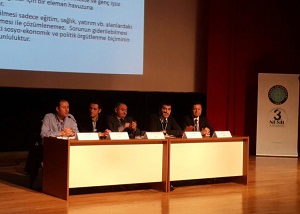
The 8th Uludag International Relations Conference, titled “State and Non-state Actors in the Regional and Global Systems”, was held by the Uludag University Department of International Relations on November 28-29, 2016. The conference was co-supported by the Directorate of Foreign Relations of the Office of the Prime Minister, the Ministry of Foreign Affairs of Turkey, the Diplomatic Academy of the Ministry of Foreign Affairs of Turkey, the Metropolitan Municipality of Bursa and the Center for Iranian Studies. On the first day of the conference, a panel was organized by ORSAM. ORSAM economic research advisor Prof. Harun Ozturkler, ORSAM researchers Mr. Oytun Orhan, Mr. Bilgay Duman and Mr. Bedi Celik, and ORSAM research assistant Mr. Sertac Canalp Korkmaz participated in the panel as speakers.
The session’s moderator Prof. Harun Ozturkler started the panel with his presentation entitled “Youth Unemployment Issue and Radicalism in the Middle Eastern and African States”. Ozturkler marked unemployment as a significant factor in the process of youth radicalization in the Middle East and North Africa, and stated that the problem of youth unemployment should be handled not only by means of economic investment, but also by democratization.
In the panel, ORSAM researcher Mr. Oytun Orhan gave his presentation entitled “Sectarian Dimensions of the Syrian Civil War and Rising Non-State Actors”. Orhan stressed the presence of multiple non-state actors with different sectarian identities in the ongoing state of war in Syria as a factor hampering the resolution of the conflict.
The third presentation, entitled “Hashd Shaabi: A Controversial Actor in Iraq” was given by ORSAM researcher Mr. Bilgay Duman. Mr. Duman argued that Hashdi Shaabi, who organized the Iraqi security forces for military reinforcement, later became a ringleader in the Iraqi process.
Pointing out the administrative and social problems caused by Hashdi Shaabi’s operating independently of the central Iraqi government, Duman also drew attention to the reactions of international institutions to Hashdi Shaabi’s misdeeds in areas they retook from ISIS. Addressing a legislation passed in Iraq to legitimize Hashdi Shaabi’s activities, Duman stressed that uncertainties and concerns over Hashdi Shaabi nevertheless persist.
In the fourth presentation, entitled “Changes on the Battlefield and their Manifestation in the Syrian Civil War”, Sertac Canalp Korkmaz argued that wars, which have an important place in the history of humanity, underwent a characteristic change not only in the framework of wars themselves, but also in the framework of their spatiality. Highlighting the increased number of actors on the battlefield as an important development, Korkmaz also argued that changes on the battlefield can be seen vividly in the case of Syria both spatially and in terms of the number of actors.
ORSAM researcher Bedi Celik gave the fifth and final presentation of the panel, entitled “An Analysis of Turkish Speaking ISIS Supporters on Twitter”. Arguing that Twitter used to provide a broad field of operation for ISIS, Celik said that over 300,000 Twitter accounts were either suspended or terminated during the cyber fight against ISIS. Celik stated that Turkish speaking ISIS supporters actively use Twitter, and argued that contrary to expectations, their primary agenda is not religious propaganda, but the PKK terrorist organization.

23.06.2025
All Rights Reserved 2012 - 2026 | Orsam


 Google Calendar Add


