
Filtre

Type the word you want to search for
5 minute reading time
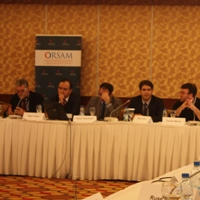
ORSAM organized an international workshop entitled “The State of Affairs in Foreign Terrorist Fighters Research Workshop” on 23 January 2015 in Ankara. Many academics, researchers, experts, and journalists from all around the world have shown great interest to the workshop. The workshop aimed to provide a contribution to the conceptualizing process about the foreign terrorist fighters. Researchers and experts presented several papers in specific sub-titles and made condense discussions at the workshop. The workshop was organized by Assoc. Prof. Haldun Yalçınkaya, ORSAM Coordinator for Security Studies.
In the first session of the workshop, the foreign terrorist fighters from past to present were discussed. In this context, two papers were presented: “Turkey and Foreign Terrorist Fighters” and “Development of Foreign Terrorist Fighters in historical perspective in the North Caucasus and its reflection on the conflict in Syria.” Various comments and discussions on the evolution of foreign terrorist fighters from past to present took place in the debate stage of this session. In this session, it was determined that, ever since Afghanistan was invaded by the Soviet Union, the foreign terrorist fighters have increasingly been used in Afghanistan, Bosnia and Herzegovina, Somalia, Chechnya and Iraq for more than 35 years and today they have become very active.
The second session was on Radicalization and Violent Extremism. In this session first of all two papers were presented: “Countering the Misuse of Holy Text in Terrorism” and “The Foreign Fighter Problem and Western Europe.” In the debate stage, participants discussed and made comments on the effects of radical interpretation of Islam.
Prevention of foreign terrorist fighter travels as well as national and international measures for the prevention of foreign terrorist fighters was discussed in the third session of the workshop. Striking figures regarding foreign terrorist fighter’s use of Turkey as a transit route were presented by Ministry of Foreign Affairs, Republic of Turkey. Secondly, the measures were taken by Australia against the foreign terrorist fighters were also presented by the Embassy of Australia. Changes and recommendations carried out in the Australian domestic law about this issue have been noted as a remarkable attempt. Thirdly, the University Of Maryland Center Of START’s (Study of Terrorism and Responses to Terrorism) works related to individual radicalization which were carried out in the United States was presented. Lastly, sharing travel information in the international environment and the effects of national measures on the radicalization was discussed.
In the fourth session, returns and proliferation of the foreign terrorist fighters were mentioned. Two different presentations about the UN Security Council Resolution 2178 on foreign terrorist fighters and analysis of the implementation of this resolution have been discussed during the session. In this context, the discussions were focused on the legal aspects of changing the concept from foreign fighters to the foreign terrorist fighters.
In the last session of the workshop moderators summarized some issues highlighted throughout the day.
Presentations and topics discussed in the workshop are presented below.
1st SESSION: FTFs past and present
MODERATOR
Assoc. Prof. Dr. Şaban KARDAŞ, ORSAM Director
“Turkey and Foreign Terrorist Fighters”
Assoc Prof Dr Haldun YALÇINKAYA, ORSAM Coordinator for Security Studies
“Foreign Fighters in the North Caucasus and Russian-speaking fighters involved in the conflict in Syria”
Dr Cerwyn Moore University of Birmingham
Discussion Topics
-From “Foreign Fighters” to “Foreign Terrorist Fighters”
-Lessons learned from Afghanistan, Bosnian War, the Caucasus, Iraq and Somalia
-Changes in paradigms? From Al Qaeda to ISIS
-Impact of FTFs on the conflicts now and future
2nd SESSION: Radicalisation and Violent Extremism
MODERATOR
Assist Prof Dr Mehmet Özkan, UTSAM
“Countering the Misuse of Holy Text in Terrorism”
Prof.Dr. Şaban Ali Düzgün, Ankara University Faculty of Divinity
“The Foreign Fighter Problem and Western Europe”
Prof emeritus Dr Alex Peter Schmid, Research Fellow, International Centre for Counter-Terrorism(ICCT)
Discussion Topics
– Patterns in radicalization and recruitment
– Prevention of radicalisation, recruitment and travels
-The dynamics of FTF radicalisation: internet; extremist preachers; recruiters, defining vulnerability at various levels, role of ideology, identity and perceived grievances etc.
-Violent Extremist Narratives and Counter-Narratives: Elements of extremist ideology; preventing dissemination; challenging the abuse of religion, determining counter narratives: who should and by which means to counter?
3rd SESSION Intercepting travels, national and international responses
MODERATOR
Ambassador Thomas Krajeski, US Senior Advisor for Partner Engagement on Syria Foreign Fighters
“Measures against Foreign Terrorist Fighters ”
Alper Yüksel, Head of Department for Security and Intelligence, Ministry of Foreign Affairs, Republic of Turkey
“Australia’s Approach to Foreign Terrorist Fighters”
Ambassador James Larsen Australian Embassy in Ankara
“Foreign Fighters and the Economy of International Terrorism”
William Braniff, Executive Director, National Consortium for the Study of Terrorism and Responses to Terrorism, University of Maryland
Discussion Topics
-Intercepting travels to and from the conflict area
-Stages of radicalisation and travel. Various processes pertaining to the decision to travel, radicalization leading to travel, radicalization after travel. Facilitators and networks involved in radicalization and travel.
– The role and impact of the radicalized that choose to stay back.
– Foreign Terrorist Fighters within a broader economy of resources that are mobilized to support violent conflicts.
– Social Media and the nature of radicalization and mobilization.
– Datasets and/or Cases
4th SESSION: Returns and Proliferation of FTFs.
MODERATOR
Prof emeritus Dr Alex Peter Schmid, Research Fellow, International Centre for Counter-Terrorism(ICCT)
“Foreign Terrorist Fighters and UN Security Council Resolution 2178”
Suleyman Ozar, International Institute for Justice and the Rule of Law (IIJ)
“CTED's Analysis of the Principal gaps in Member States' capacities to stem the flow of foreign terrorist fighters pursuant to Security Council Resolution 2178”
Aleksandra Dier, Political Affairs Officer, Counter-Terrorism Committee Executive Directorate
(CTED) United Nations – New York
Discussion Topics
– Analysing and managing returns: security risks, state responses to returns (legal, social, administrative) and their impact on the FTF travels/proliferation; international cooperation
– Impact of UNSC Res 2178, enhancing national and international measures: new legislations, regional/global initiatives, law enforcement cooperation etc.
– Other international efforts to counter the problem

23.06.2025
All Rights Reserved 2012 - 2026 | Orsam


 Google Calendar Add


