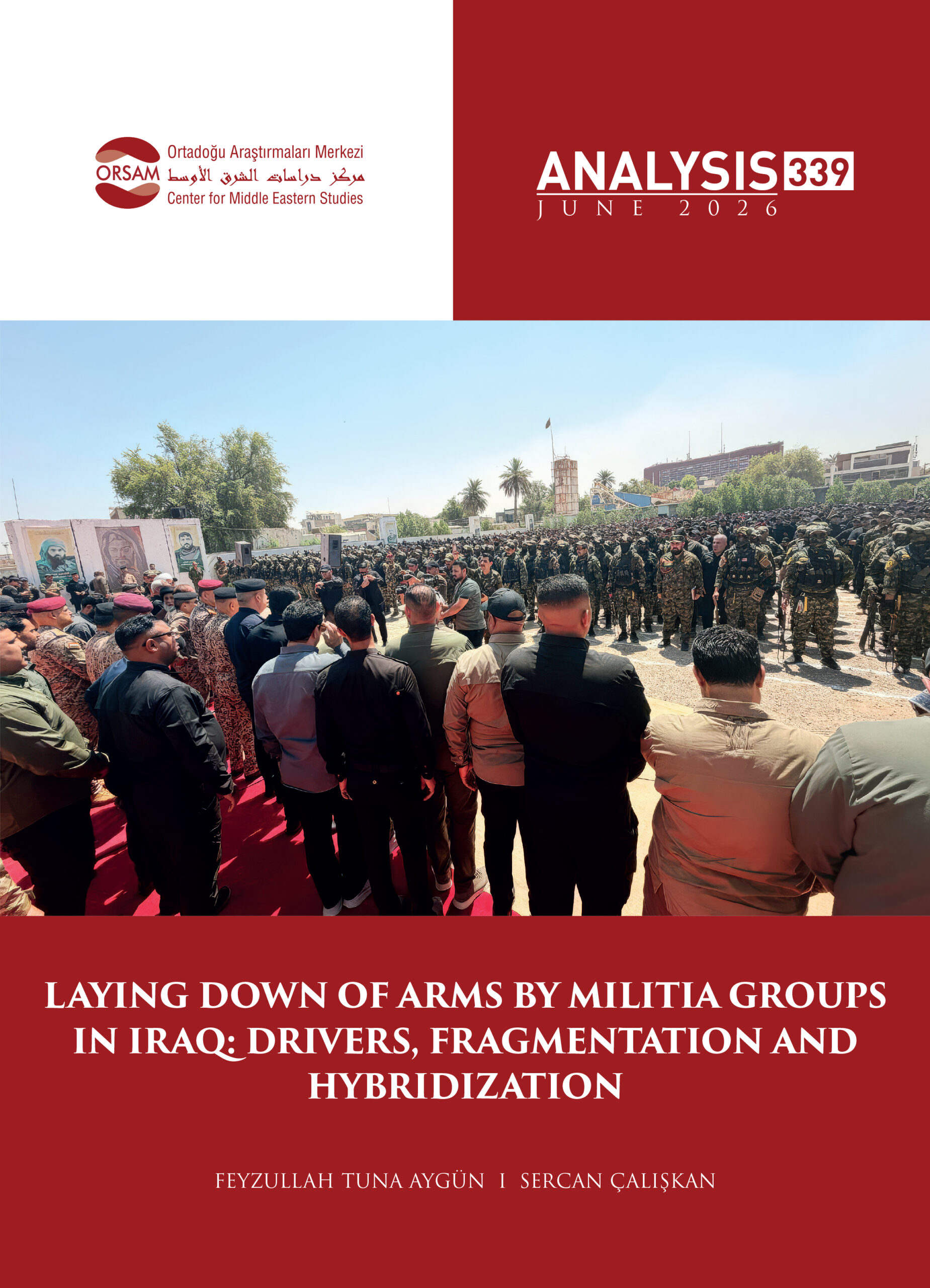
The announcement by Asaib Ahl al-Haq, Saraya al-Salam and Kataib Imam Ali that they are prepared to withdraw from the Popular Mobilization Forces (PMF, also known as the Hashd al-Shaabi) and hand over their weapons to the Iraqi state marks one of the most significant developments in Iraq’s post-DAESH security landscape. Established after the DAESH seized Mosul in 2014, the PMF gradually evolved into a force of roughly 200,000 armed personnel with a massive budget. Beyond serving as a security force, it has become one of the main pillars of Iraq’s Shiite political order. As such, the decision represents more than an institutional choice by the three groups; it signals a redefinition of the relationship between the state and armed actors in Iraq.
The way the decision was announced is as significant as its substance. By framing the move in terms of “the country’s interests” and “the guidance of the religious authority,” the groups sought to present disarmament not as a response to external pressure but as a step shaped by Iraq’s own political and religious legitimacy mechanisms. Given the influence of the Najaf-based religious establishment in Iraqi politics, this emphasis also serves a critical role in preserving the groups’ social support.
At the same time, assessing the political context of the decision and its implications for Iraq’s security landscape requires an understanding of the country’s security architecture. Since 2003, the boundaries between state institutions and armed groups in Iraq have become increasingly blurred. Although the PMF were formally incorporated into the state’s security apparatus under legislation passed in 2016, many of the factions within the organization have continued to maintain their own command structures, political ties and economic resources. As a result, the current debate over the handover of weapons extends beyond a military or administrative measure; it forms part of a broader discussion about the scope of state authority.
The key question, therefore, is whether Iraq is genuinely moving toward dismantling armed groups or simply repositioning them within the state. If the process results in the elimination of independent armed capabilities, the centralization of the chain of command and the transfer of all security decision-making to state institutions, it would mark a significant strengthening of Iraq’s state capacity. If, however, the weapons are formally transferred to the state while these groups retain their own command structures, political influence and organizational networks, the outcome would amount to little more than militias operating under a different guise. The significance of the decision, therefore, lies less in the announcement itself than in how it is implemented. While the move represents an important milestone in Iraq’s long-standing effort to establish the state’s monopoly on the use of force, the ultimate outcome will depend on the nature of the new relationship between the state and these armed groups.
This study examines the disarmament and integration process of militia groups in the context of Iraq’s domestic political dynamics, U.S. influence over Baghdad and the evolving landscape of Shiite legitimacy. It first explores the conditions that gave rise to the disarmament decision and its implications within the PMF. It then examines U.S. pressure on militia groups alongside the security vision of the Zaidi government. The study also analyzes the role of the Najaf-based religious establishment and the competition among Shiite political actors. Finally, it assesses the hybridization of militia groups in light of their disarmament and emerging institutional role.