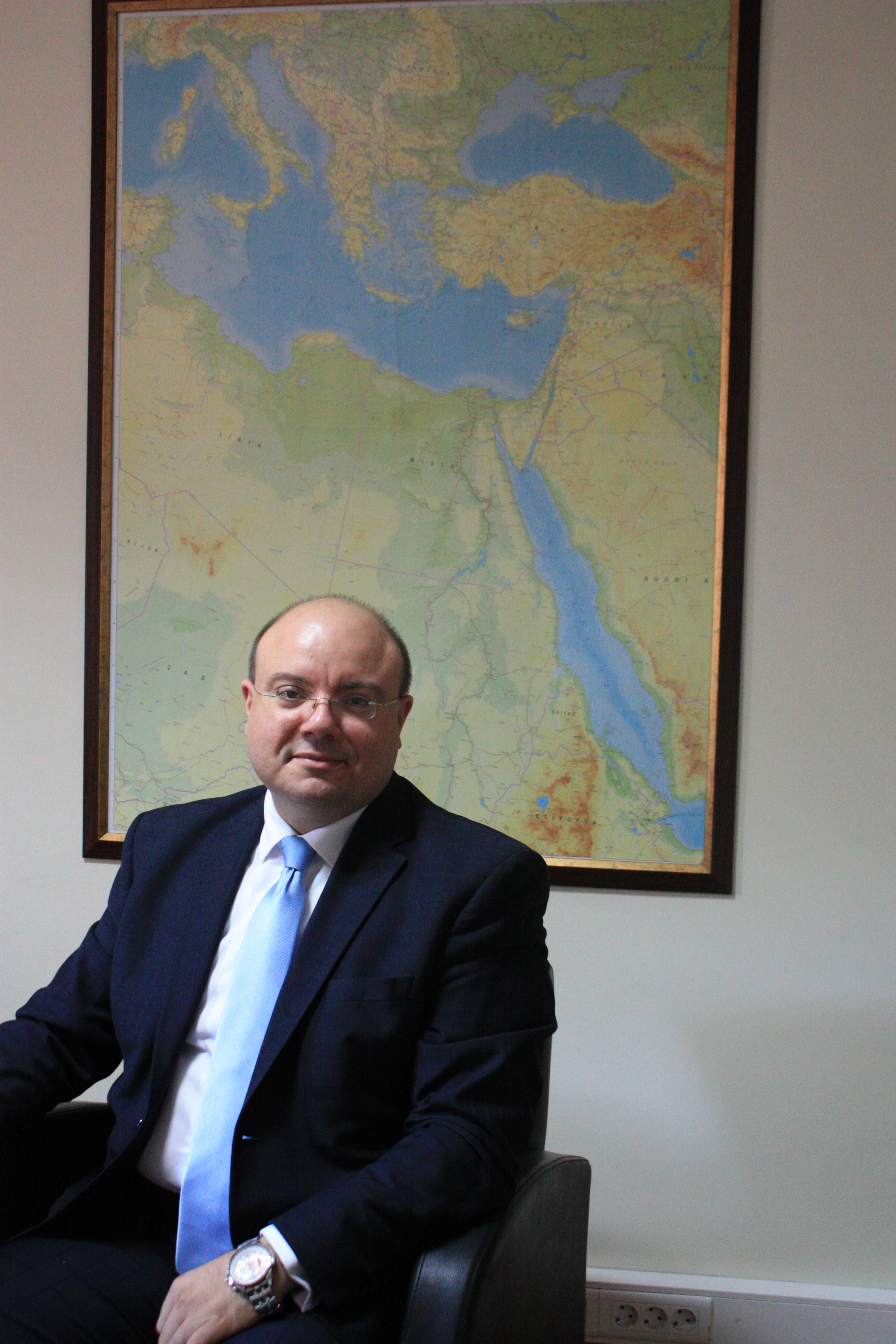
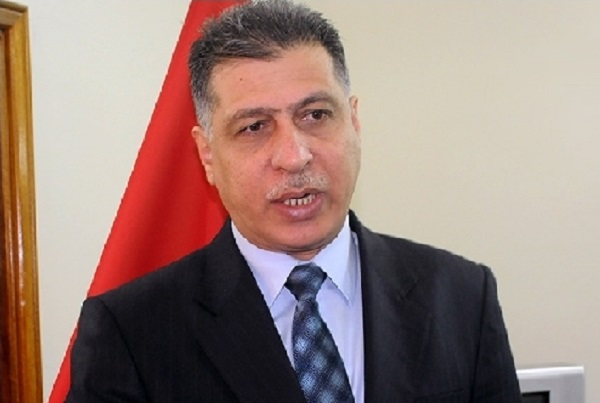
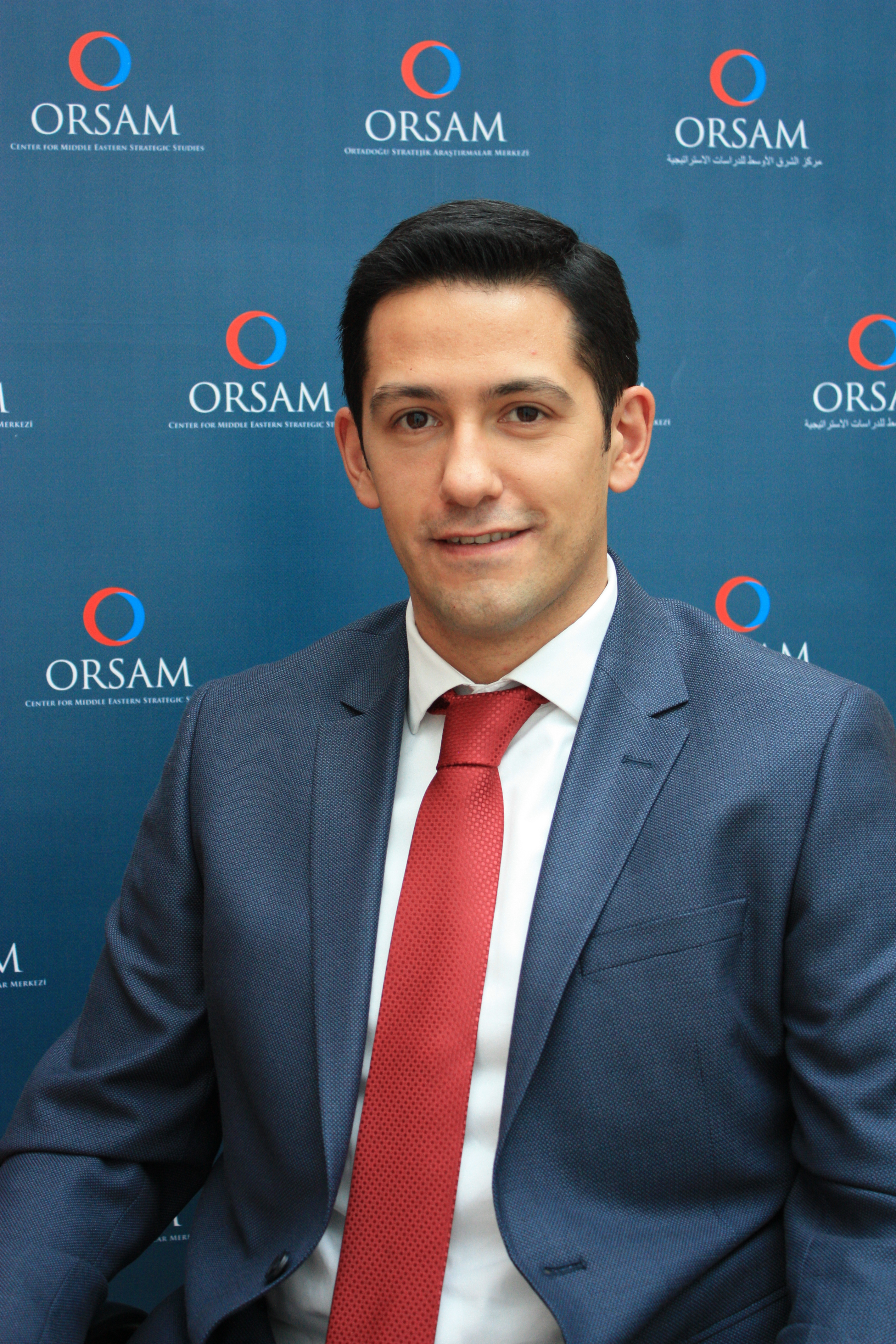
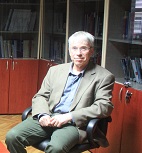
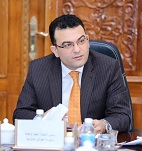
The Syrian National Coalition is still recognized as the legitimate representative of the Syrian people by many countries and international organizations. The Coalition, in which different groups among the Syrian people are represented, still serves as the largest opposition umbrella organization representing the Syrian opposition. The Coalition has representation offices in various capitals of the world. We had the chance to make an interview with Oubab Khalil, the Washington representative of the Coalition, in Jordan. Khalil shared his views on the current situation in Syria, the activities of Coalition, and on the solution of Syria problem.
OUBAB KHALIL: “AS AN ALAWITE, I DISAPPROVE OF THE QUOTA SYSTEM IN SYRIA”
ORSAM: Could you briefly introduce yourself?
Oubab KHALIL: My name is Oubab Khalil. I am an attorney and I have a law degree. I practiced law in Syria until I left in 2006, I worked in real estate in the United States and I had been doing some “civil work”, or lets say non violent work in 2005 against the Syrian regime that was cracked down on. I wasn’t detained or anything due to various factors that I’m not going to bore you with right now, but as soon as the revolution started, I was out in the street, running, and I contributed to the organization, I was trying to immediately see what we could do to promote a revolution undergorund on many levels. I am an elected board member of the Syrian Expatriots Organization and I serve now after my term on its advisory board and I served until very recently on the board of the Syria Support Group. It was the only organization that got license to deal with and to try to help to contribute to organizing the Free Syrian Army; back in February, I was asked to serve as the chief of staff for the Syria Colalition Mission to the United States.
ORSAM: It has been more than two years since the uprising started in Syria. At first it was completely civil demonstrations, then it turned to an armed clash between the army and the armed opposition. How do you see the current situation in Syria, the power balance between the regime and the armed opposition, economic conditions and the security situation?
Oubab KHALIL: This is a very, very broad question, let me try to touch base on a few important things on the subject. We have in the coalition, which is the civillian leadership, 116 countries that recognize us as the legitimate representative of the Syrian people. The three countries that are supporting the regime, which are Iran, Russia and China are doing more than the 116 countries combined. What is causing the imbalance of power is what we have. What we really have are forces in survival mode against a regime that is very, very well armed with heavy weaponry, tactical weaponry and strategic weaponry; they have missiles, airplanes, very advanced weapons and there is proof of the use of sarin gas which is a chemical weapon used four times so far in Syria. This is what we have going alone, due to our lack of help, due to an inability to support any of the mainstream or the army defectors or moderate forces, this contributed to the lets say, the emergence of radical groups, which are growing by the day. I think the whole notion right now if we look at it from an opposition standpoint, when we look from the international society, is that this is a Syrian struggle that we can take on ourselves if we had a level playing field, if we had the conditions for a fair fight, that’s why we ask for a no fly zone, or strategic weaponry. Let me touch on a no fly zone becaue its a really important issue and they always say why do you go back to it. Because I think its really inavoidable, I think it has to be considered because we heard today that 2,000 refugees per day are crossing into Jordan; there are over 8,000 crossing into Turkey, Jordan and Lebanon on a daily basis.Turkey has the most durable ability to deal with this, but other countries will not have the ability to cope. We need to have it so Jordan and Lebanon do not collapse from this. Another thing is that we need to be able to stop the influence of radicalization or fragmentation that is happening. We currently have a safe haven where we can have civil governance, Civil governance is already happening, we need to bring all sides together in a systematic, civilized and institutionalized way that can be applied to and exercised in the whole country and this is really very hard to do while under attack or to implement policy on a statewide level.
ORSAM: The first political opposition group was Syria National Council which was established in Istanbul. There was a lot of criticism to the Council that it was not united and it was not representing the Syrians. Now we have the National Coalition that was established in Qatar. What can you say about the current situation of the Coalition and their efforts, do you still face the same criticism?
Oubab KHALIL: I’ll start with the council, what I can say is we cannot 100% blame the council for everything because for 6 months the Syrian National Council did not get any support. The coalition is different because the coalition is founded to be able to form a government. There are several issues, the first of all is representation. I don’t think you can have real representation if you don’t have free elections in a free country that is not under occupation. Maybe you could bring some Christians or Alawites or Druze but you are not really having representation because the real representation we need is a fair game or a fair election and a fair fight and competition between political parties and ideology, we don’t need the representation of the court system, the liberal model or the Iraq model, we really need a citizenship model where it is based on the competion of ideologies not various races or ethnic groups. So, the coalition itself, it is a coalition of joint and multiple various political groups, so it cannot be united because the whole idea of this unity kind of contradicts with the whole concept of democracy allowing there to be all sorts of views, we agree that there is a need to get rid of the old regime, follow the Geneva Comminuque in broad terms or according to the US interpretation, that is exactly why we need an executive form of government, the way we envision the Etilaf or the Syrian coalition is to kind of keep a legislative eye on the government that can set wide parameters that people can all agree on. There is a very important reason why we call this an interim government, it is because we believe that every struggle has to end with a political solution and an enforcable political solution. We wanted to use an interim government so we can leave the way open for a transitional government should the whole atmosphere or enviromnent become ready for a full government that can have full executive authority over our security and military forces. I think if we don’t move towards this executive body, as a Syrian citizen, not for anything else, we need managers who can take orders and make sure essential systems are working, that is what I see and I hope that we are getting very close to achieving that with the coalition.
ORSAM: It seems that the US will push for a political solution in Syria in the coming period. What is the Coalition’s approach for the political solution?
Oubab KHALIL: Well, first of all, the coalition will have a detailed position in the coming days, that’s why there is a meeting very soon in Istanbul to discuss all of this. However, the initial reaction from the coalition is can we mean this? Can we reckon all this? But we need at the same time all of our friends including the United States, it is so essential not to stop any help, to actually increase all help to contribute to creating the right environment for negation. The general attitude we always said is we are ready to negotiate on a meaningful level, on a balanced level on the departure of the regime. We are not, at least on a personal level, should negotiate on a power sharing, it should be on a power transition. There we have a transitional government with an acceptable remnant element of the regime without Syrian blood on their hands. It’s the main leaders who ordered the killings, its not the soldiers fighting on the street, we are talking about the high leaders, we are not talking about tens of thousands, we are talking about the high hands. We recognize the difference between government institutions and the regime and we want the continuity of government institutions in Syria.
ORSAM: There are a lot of scenarios regarding the future of Syria. What is your expectation for the post Assad era and what is the Coalition’s position regarding the political and social structure of Syria?
Oubab KHALIL: We had so many groups from different ethnicities and backgrounds say we need one Syria, we need a unified Syria. The general notion, me myself, I am of an Alawite background, I really refuse the quota system, I refuse an Alawite quota, I think that’s what will build a country, I like to see ideological alliances. I couldn’t care less whether I see an Alawite or a Christian; I care to see someone who is aligned with my thinking on government, economics, social, equality and gender equality and woman’s representation. I think the only quota there should be until the society is ready to accept is a quota for woman. How much of a quota is a very difficult question, about 60% of people in Syria are women and I think that its very very important to be included in every like step and protected by a quota until the whole education and whole environment can provide them a fair world over there.
ORSAM: The political opposition which is mainly outside Syria does not have real leverage over the armed opposition inside Syria. What can you say about that situation, what is Coalition doing to overcome this problem?
Oubab KHALIL: Well the only people we really recognize are the Syrian Military Council which is under chief of staff General Salim Adris as the legitimate armed groups under the coalition that submit to a civilian. This question gets asked a lot, however the answer is really rather simple. However, people aren’t doing this because we need international coordination to unify funding, to make sure finances are done for the Syrian Military Council. Then the Syrian Military Council can send the money to the battalions or brigades on the ground. This is the only way we can fight extremism because extremists are not waiting and they will not wait. They know that like any international penny, they will not have a share of it, they know that very well and they have their own finance system and they are very well funded and that’s how they are able to operate on the ground. For a year, we did not hear about any extremist group in Syria. Even when we talk about extremists, we need to talk about the right groups. Even when we talk about the regime its self we need to remember that the regime turned a blind eye on extremists that they sent to Iraq to kill Americans and destabilize Iraq, when they went on honeymoon with the US, they killed them and when the revolution happened, they unleashed them again. We have the veterans who are hardcore extremists who didn’t die in Afghanistan or Iraq and they want to be Martyrs and go to heaven and we have the people, many of who are secular who made awful choices to surprisingly join extremist groups because of economic or personal reasons like losing their entire family, These people want to join the most effective fighters which are the radicals. The risk of inaction and not unifying military support behind one body would actually contribute to more fragmentation and to empowering radicals.
ORSAM: What do you think about Turkey’s Syria policy? Are you satisfied with Turkey’s support or are you expecting more?
Oubab KHALIL: Turkey is giving alot, we really appreciate that, but we can really ask any and every country for more. We ask them for more pressure or to try to work with more regional powers in an institutional framework, to unify funding that can be agreed on regionally, which we believe is the Syrian Military Council under General Salim Adris. We believe that they can put continued pressure on the international community to help the Syrian people, especially with a no fly zone. We believe that Turkey is one of the countries that can help the Syrian people the most while making sure that they still maintain political sovereinty. That is something that we don’t see often while dealing with other nations; we believe that Turkey has layed the foundation for strategic relations between Syria and Turkey for decades to come.
ORSAM: Thank you very much.
* This interview has been conducted on May 21, 2013, by ORSAM Chairman Hasan Kanbolat and ORSAM Researcher Oytun Orhan in Jordan.