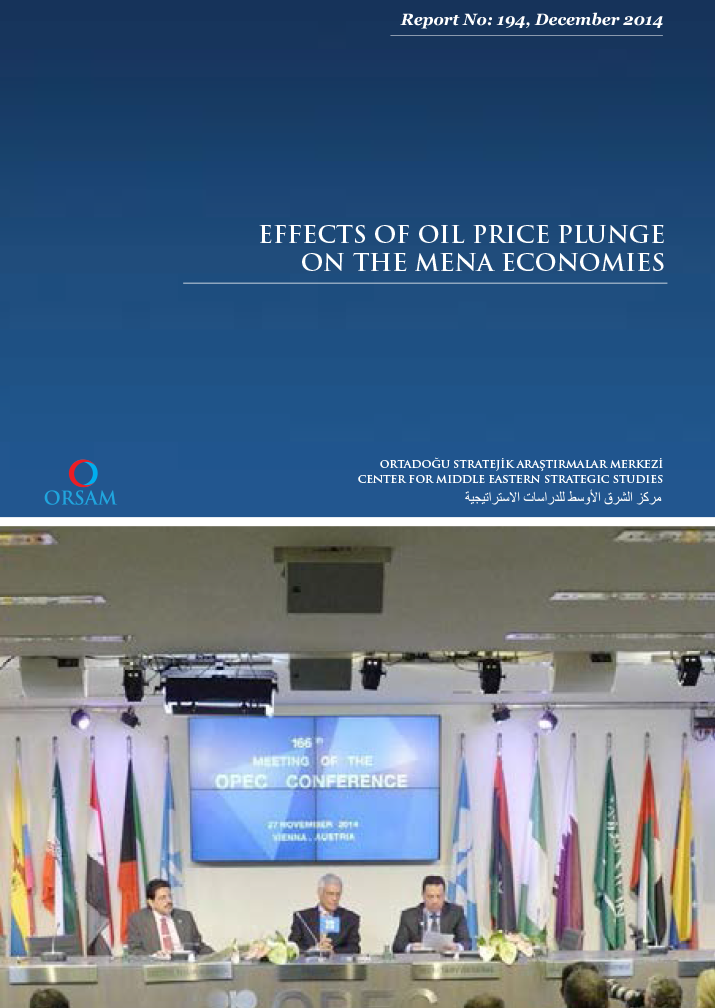
There was a rapid decrease in oil prices in the last four months and the price of the Brent oil per barrel fell below $ 80 at the beginning of November for the first time in the last four years. It was decided during the Organization of Petroleum Exporting Countries (OPEC) meeting that took place in Vienna on 27 November that the oil supply could not be decreased. This decision led the price of oil (per barrel) to decrease to $ 71. The price of oil (per barrel), which dropped to $60 following the Mortgage Crisis of 2008, started to increase due to the rapid growth trend in the developing countries and the expectation of decline in the oil supply with the Arab Spring. The prices that had increased to $ 160 were over$ 100 for the last 4 years.
The changes in the oil prices are crucial for the world economy since oil has still been one of the primary sources of energy and is used in several sectors as raw material. It can be expected that gradually decreasing oil prices will have positive effects on inflation, mainly because it will decrease the cost of input in the oil importing countries in the short-run. At the same time, it will also create a positive impact on the external trade balance and growth due to the fact that these countries will have to pay less in foreign exchange. In terms of the middle-run consequences, the demand shrinkage in the oil exporting countries may bring in negative effects since it will lead to a decrease in the exports of the countries trading with the oil exporting countries.
The decrease in prices is also a sign of bad times for the oil exporting countries. The continuation of the low prices carries high risks for the OPEC countries and the Middle Eastern economies which are heavily dependent on oil. The regional countries have confronted serious economic problems in the last four years because of the political instability in the Middle East and North Africa (MENA). The decrease in oil prices will lead to shrinkage in the economies of the region. This situation can cause an increase in political instability originating from the decrease in public expenditure and increase in unemployment.