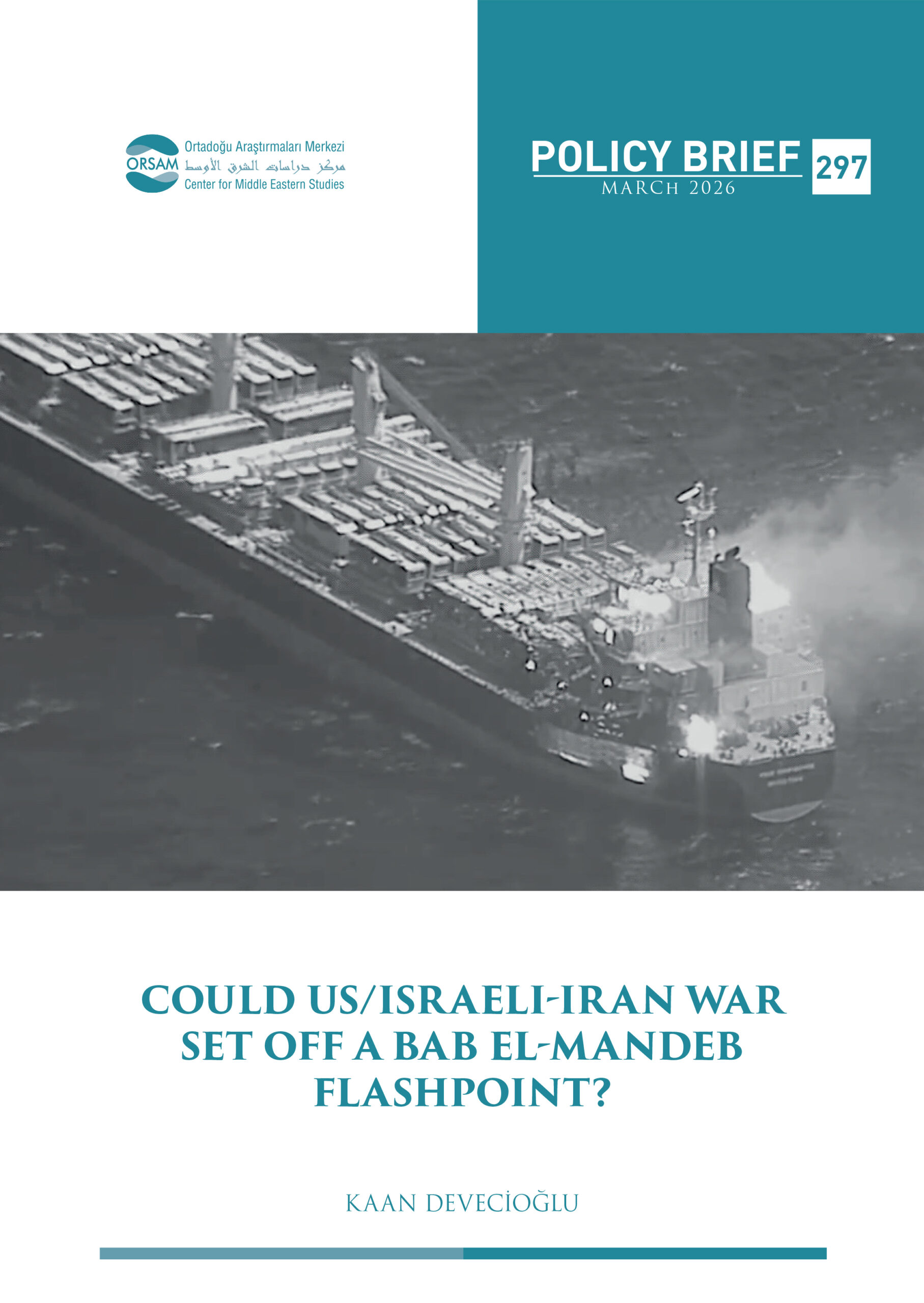
The military attacks launched against Iran by the U.S. and Israel on Feb. 28, 2026, can at first glance be seen as a new phase in the power struggle centered on Tehran. However, this development should be read not only as an operation targeting Iran’s military capabilities, but also as a multilayered geopolitical rupture that could simultaneously affect the deterrence architecture of the proxy network defined as the “axis of resistance,” the Red Sea security architecture, and the subregional balance of power in the Horn of Africa. Therefore, the issue is not a crisis limited to the Iran-Israel-U.S. triangle; it is a process that could redefine security, trade and sovereignty dynamics across a broad geography stretching from Bab el-Mandeb to Assab, and from the Gulf of Aden to Mogadishu.
The main research question of this study focuses on whether U.S.-Israel attacks against Iran will trigger a new cycle of militarization in the southern Red Sea or lead to a prolonged period of uncertainty through controlled deterrence. Three main lines of argument emerge in addressing this question. The first is Iran’s capacity to close its deterrence gap through proxy actors and its implications for Bab el-Mandeb. The second is the new security architecture that could emerge on the African coast following Israel’s recognition of Somaliland, and how this will be perceived by the Houthis and Iran. The third is how the military buildup in the Red Sea could affect land geopolitics in the Horn of Africa, particularly Ethiopia’s quest for access to the sea and the balance along the Eritrean line.
In this context, the article puts forward three hypotheses. The first hypothesis is that although the Houthis’ current rhetoric points to a strategy of “controlled deterrence” rather than direct military escalation, their approach of maintaining Bab el-Mandeb’s potential for escalation as a means of pressure keeps alive the risk of permanent militarization. The second hypothesis is that possible security cooperation between Israel and Somaliland could move Somaliland beyond being merely a diplomatic actor and draw it into a proxy war dynamic, with the potential to generate new instability in the Horn of Africa. The third hypothesis is that as the crisis in the Red Sea drags on, Ethiopia is increasingly likely to bring the issue of access to the sea to the fore as a “geostrategic necessity,” using harsher tools and creating a risk that could escalate from controlled tension to actual conflict on the Ethiopia-Eritrea front.
In this context, the article discusses four main scenarios:
- The Houthis limiting themselves to symbolic solidarity and postponing military engagement, causing the crisis to enter a phase of “prolonged uncertainty”;
- The permanent militarization of the Red Sea with the resumption of hybrid naval attacks in Bab el-Mandeb;
- Israel-Somaliland security cooperation turning the African coast into an indirect conflict zone;
- Ethiopia taking advantage of the distraction created by the Red Sea crisis to attempt to create a fait accompli along the Eritrean border, opening up a land front.
Based on this, the study analyzes whether a military crisis that appears to be centered in Iran will actually lead to a multilayered geopolitical realignment along the Red Sea-Horn of Africa axis. The aim is to assess the risk of regional escalation not only in military terms, but also in the context of economic fragility, sovereignty disputes and subregional power hierarchies. In this regard, the study seeks to show how a small trigger can lead to large-scale strategic consequences in a geography oscillating between open warfare and controlled tension.