Filtre

Type the word you want to search for
January 2026 marked a period in the Sudan war in which unmanned aerial vehicles (UAVs) became a decisive factor, and the conflict was reshaped both geographically and in terms of its actors. Throughout the month, intensive UAV strikes were carried out along the Darfur, Kordofan, Blue Nile and Khartoum corridors, directly targeting civilian infrastructure, hospitals, power plants and border areas.
During this period, the Sudanese Armed Forces (SAF) made limited territorial gains in South Kordofan and Blue Nile, while the Rapid Support Forces (RSF) increased psychological and logistical pressure through concentrated drone attacks on urban centers. Attacks extending to the Chad border indicate that the war has now formally entered a phase of regionalization.
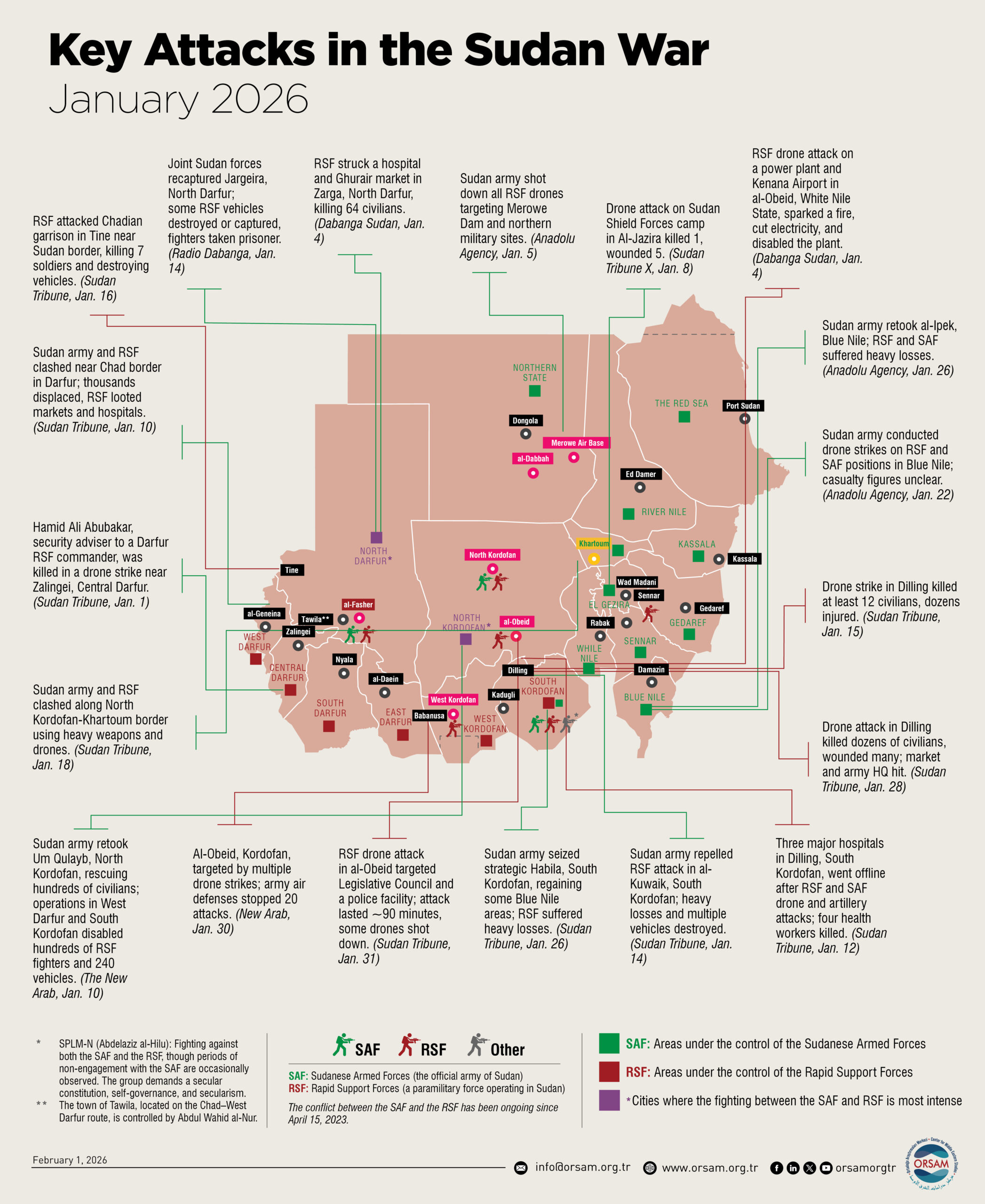
Darfur (Zalingei-Zarga-Jargeira corridor):
On the first day of January, the killing of Hamid Ali Abubakar, the security adviser to an RSF commander, in a UAV strike near Zalingei in Central Darfur demonstrated the SAF’s capacity to conduct high-level targeted operations. However, the Jan. 4 RSF drone strike on a hospital and the Ghurair market in the Zarga area of North Darfur, which left 64 civilians dead, showed that civilian targets in Darfur were being systematically hit.
Clashes that resumed Jan. 10 in areas near the Chad border displaced thousands of civilians. On Jan. 14, the Sudan Joint Force announced it had recaptured Jargeira, underscoring that control in Darfur remains fragile and fluid. In January, Darfur became the epicenter of both targeted assassinations and mass civilian casualties.
North and South Kordofan (Dilling-Habila-al-Obeid corridor):
Kordofan became the main focal point of fighting in January. On Jan. 10, the SAF announced it had retaken Um Qulayb and rescued hundreds of civilians, signaling a renewed acceleration of ground operations. The capture of al-Kuwaik and Habila in South Kordofan on Jan. 14 and Jan. 26 marked the most significant territorial gains since late 2025.
However, UAV and artillery strikes in Dilling on Jan. 12, Jan. 15 and Jan. 28 killed dozens of civilians and put three major hospitals out of service, indicating the region has reached the brink of humanitarian collapse. Kordofan is no longer solely a military front but a crisis zone marked by the concentrated destruction of health services and infrastructure.
Intensive UAV strikes on al-Obeid on Jan. 30-31 were carried out in a coordinated operation lasting about 90 minutes, targeting the Legislative Council and police facilities. Although the army said it shot down more than 20 targets, the scale of the attacks indicates that the RSF’s operational capacity has increased.
Blue Nile (Damazin corridor):
Infrastructure attacks that began Jan. 4 with RSF strikes targeting the power station in al-Obeid and Kenana Airport entered a new phase on Jan. 8 with a strike on the main power station in Damazin. Widespread power outages were reported in Damazin, and the city faced an energy crisis for weeks.
SAF drone strikes on positions in Blue Nile on Jan. 22 and Jan. 26 indicate that the army has gained ground along the southern front. However, the sustainability of these gains remains uncertain due to the presence of the Sudan People’s Liberation Movement-North (SPLM-N) in the region.
Border Areas and the Trend Toward Regionalization:
On Jan. 16, an RSF attack on the Birak garrison of the Chadian army in the Tine area along the Sudan-Chad border, which killed seven Chadian soldiers, demonstrated that the conflict has clearly taken on an international dimension. Similarly, reciprocal UAV strikes along the Adikong and Merowe corridor indicate that Sudan’s airspace has evolved into a cross-border security risk.
Sudanese Armed Forces (SAF)
Rapid Support Forces (RSF)
Sudan People’s Liberation Movement-North (SPLM-N)
Slows SAF advances by operating simultaneously or in parallel with the RSF along the South Kordofan and Blue Nile front.
Short-term outlook: Fighting concentrated along the Kordofan front is expected to continue around al-Obeid and Dilling, while the RSF is likely to maintain attacks targeting energy and administrative facilities.
Long-term outlook: The Sudan war is shifting from a focus on territorial control to a model driven by air superiority and infrastructure attrition. This approach is expected to prolong the conflict and increase the humanitarian cost.
As of January 2026, the Sudan war has reached a phase characterized by technology-driven operations, cross-border escalation, and devastating effects on civilians. Intense attacks along the Kordofan and Darfur fronts indicate that the country has effectively entered a multi-front war. Lasting stability in Sudan now depends not only on military balance but also on simultaneous improvements in energy security, humanitarian access, and border security. ORSAM will continue to monitor this process along with its regional implications.

All Rights Reserved 2012 - 2026 | Orsam