Filtre

Type the word you want to search for
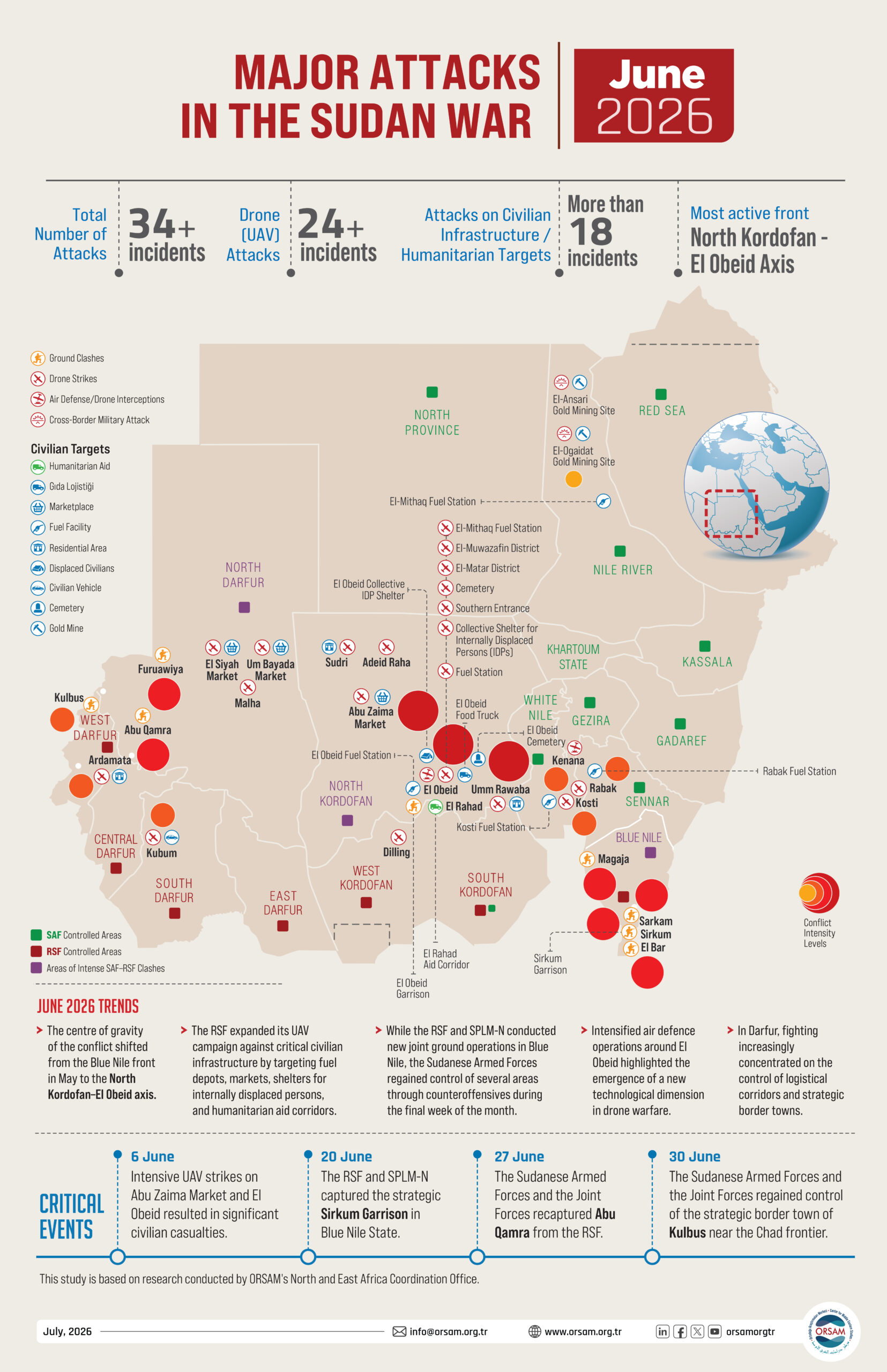
June 2026 marked a period in which the centre of gravity in the Sudan war shifted from Blue Nile back to North Kordofan, while the conflict entered a new phase through intensified drone attacks around El Obeid. Following its territorial gains in Blue Nile in May, the Sudanese Armed Forces (SAF) continued its counteroffensives in Blue Nile in June and began to regain the initiative in several strategic locations in Darfur and along the Chadian border. By contrast, the Rapid Support Forces (RSF) significantly expanded their strategy of attrition, targeting critical infrastructure, logistical routes, and civilian spaces through unmanned aerial vehicles rather than direct conventional engagements. Throughout the month, attacks on fuel facilities, markets, aid convoys, and shelters for internally displaced persons in and around El Obeid, Kosti, and Rabak demonstrated the further deepening of the war’s humanitarian and economic dimensions.
North Kordofan: El Obeid as the New Centre of Conflict
North Kordofan was the most intense theatre of the war in June. El Obeid and its surroundings were repeatedly targeted by drone attacks throughout the month; fuel stations, cemeteries, shelters for internally displaced persons, residential areas, and food logistics were systematically struck. Attacks around Umm Rawaba, Abu Zaima Market, and Sudri also showed that El Obeid was being targeted not only as a military centre but also as a logistical and humanitarian hub. In response, the Sudanese army’s air defence systems downed several RSF drones during the month, indicating an increased capacity to protect the airspace over El Obeid. Thus, in June, El Obeid became the most critical front of the war in both military and humanitarian terms.
Blue Nile: The Continuation of Counteroffensives
Following the counteroffensives that began in May, the Blue Nile front in June witnessed both the advance attempts of the RSF–SPLM-N alliance and continued counteroperations by the Sudanese army. The capture of the strategic Sirkum Garrison by the RSF and SPLM-N in mid-month showed that the struggle for power in the region remained ongoing. However, the Sudanese army’s restoration of control around El Bar, Magaja, and Sarkam in the final week of the month revealed the emergence of a dynamic and constantly shifting front in Blue Nile. This development indicates that the war has expanded beyond its Darfur- and Khartoum-centred framework into a broader geostrategic axis extending toward the Ethiopian border, while also testing the sustainability of this concentration in the region.
Darfur: Front Lines Regain Momentum
In June, drone attacks continued in Darfur, while ground operations regained momentum. Attacks on civilian areas such as Malha, Um Bayada Market, and El Siyah Market continued to directly target economic life. In response, the announcement by the Sudanese army and the Joint Forces at the end of the month that they had retaken Abu Qamra and Kulbus represented a significant development, particularly in terms of supply corridors along the Chadian border. Clashes around Furuawiya also indicated that the front lines in Darfur had become active once again.
White Nile: Systematic Attacks on Energy Infrastructure
In June, White Nile State became one of the areas where attacks on energy infrastructure intensified. While fuel stations in Kosti and Rabak were targeted by drone attacks, the downing of an RSF drone over Kenana by air defence systems showed that the struggle over energy corridors was becoming increasingly intense. Attacks on fuel facilities have important consequences not only in military terms but also for regional logistics and civilian life.
The Sudanese Armed Forces (SAF) continued their counteroffensives in Blue Nile and Darfur in June, regaining control of several strategic locations particularly in the final week of the month. At the same time, air defence activities around El Obeid and Kenana suggest that the army has begun to develop a more organised defence against the drone threat.
The Rapid Support Forces (RSF), meanwhile, built their June strategy largely around drone capabilities. Fuel depots, markets, aid convoys, shelters for internally displaced persons, and civilian settlements were systematically targeted, with the aim of weakening economic and social resilience behind the front lines. The SPLM-N, particularly the Abdelaziz al-Hilu faction, maintained its coordination with the RSF on the Blue Nile front and played a decisive role in the capture of Sirkum Garrison. However, the Sudanese army’s counteroperations at the end of the month began to limit the battlefield gains of this cooperation.
Claims of cross-border attacks on gold mining sites in River Nile State during the month also indicate that the Sudan war is intersecting more visibly with regional security dynamics.
In the short term, the RSF is expected to continue its drone attacks on critical infrastructure along the El Obeid and White Nile axis, while the Sudanese army is likely to seek to expand its ground operations in Blue Nile and Darfur. In particular, the supply corridors along the Chadian border and the Blue Nile front near the Ethiopian border will remain two key operational theatres shaping the course of the war in the coming period.
June 2026 was a period in which both the geographical and operational character of the Sudan war was reshaped. While the momentum that began in Blue Nile in May continued, the centre of gravity of the war shifted clearly toward North Kordofan, especially around El Obeid. The RSF’s transformation of drone capability into a systematic instrument of pressure targeting critical infrastructure, energy facilities, aid corridors, and civilian spaces further increased the humanitarian cost of the war. At the same time, the Sudanese army’s counteroffensives in Blue Nile, Darfur, and along the Chadian border demonstrated its effort to regain, at least partially, operational initiative.
The June data show that the conflict in Sudan has become too complex to be reduced merely to the control of cities. Energy infrastructure behind the front lines, humanitarian aid routes, border corridors, and airspace have become central components of the military competition between the parties. This indicates that the war is increasingly turning into a prolonged, technology-intensive, and multilayered struggle of attrition. In the coming period, developments along the El Obeid–North Kordofan axis and the Blue Nile front will continue to be among the most critical dynamics shaping the overall trajectory of the Sudan war.


All Rights Reserved 2012 - 2026 | Orsam