Filtre

Type the word you want to search for
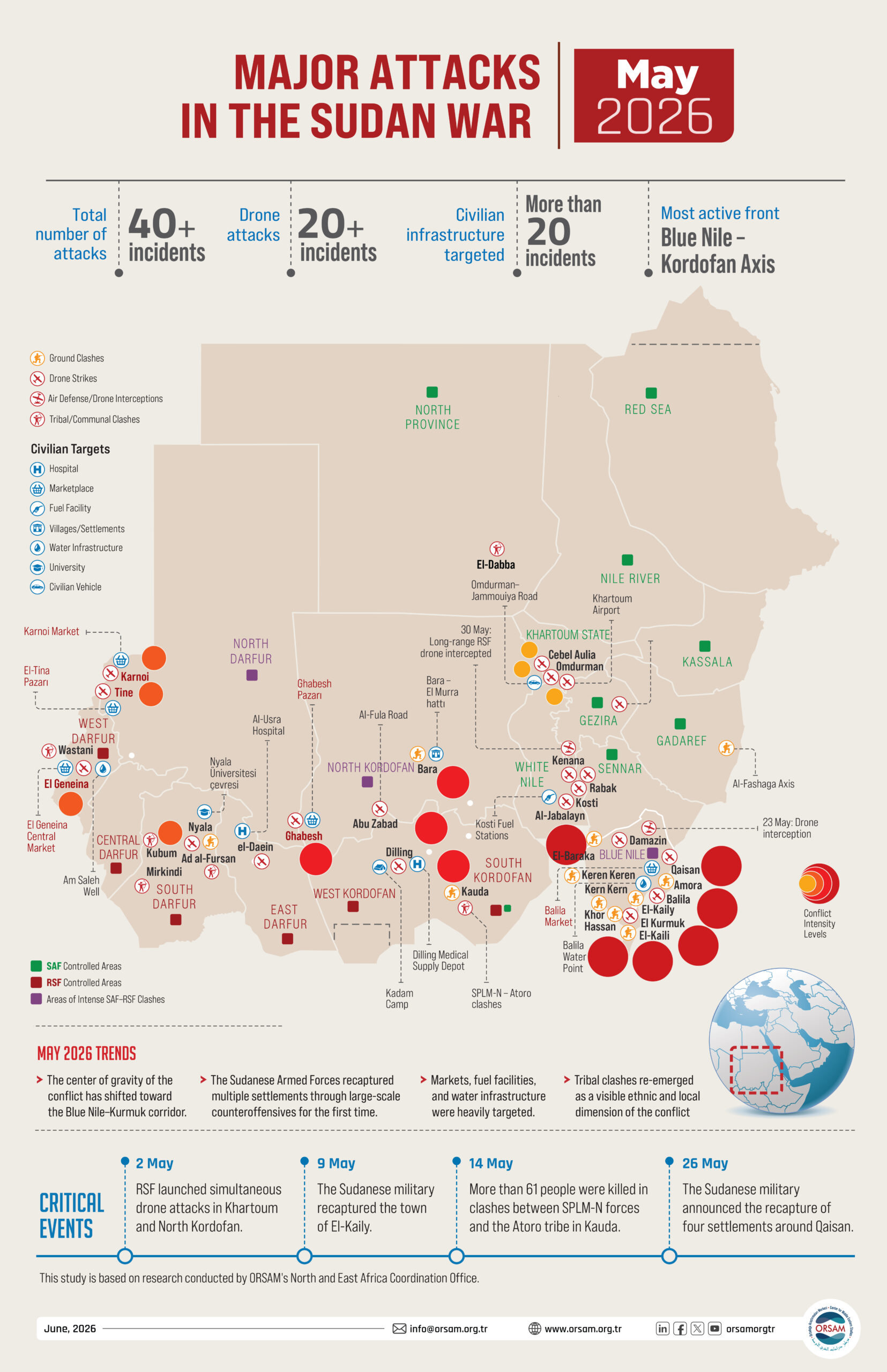
May 2026 marked a period in which the strategic center of gravity of the Sudanese conflict shifted from the vicinity of Khartoum toward the Blue Nile and South Kordofan axes. Following the Sudanese Armed Forces’ (SAF) consolidation of control over much of Khartoum, hostilities intensified particularly along the Kurmuk–Qaisan–Ed Damazin corridor. During this period, the SAF launched a series of counteroffensives and announced the recapture of several areas previously controlled by the Rapid Support Forces (RSF) and its ally, the Sudan People’s Liberation Movement-North (SPLM-N). In response, the RSF continued targeting both strategic infrastructure and civilian areas through extensive drone operations.
Khartoum: Continued Drone Pressure Following Military Consolidation
Although the Khartoum front witnessed fewer large-scale ground engagements compared to previous months, RSF drone attacks around the capital persisted throughout May. Targets included Khartoum International Airport, the Al-Murkhiyat military base, state television facilities, and various military installations.
The attacks conducted on 4–5 May against the airport area demonstrated that the RSF has not entirely relinquished its ability to exert pressure on the capital. Nevertheless, the successful interception of numerous drones by SAF air defense systems indicates that air superiority over Khartoum is increasingly shifting in favor of the Sudanese military.
Blue Nile: The New Center of Gravity of the War
The Blue Nile region emerged as the most active theater of conflict during May. Intense military operations were reported around Kurmuk, El-Kaily, El-Keili, Khor Hassan, Kern Kern, Doukan, El-Baraka, and Qaisan.
Throughout the month, the SAF announced the recapture of several towns, garrisons, and strategic positions, while RSF and SPLM-N forces reportedly withdrew toward border areas. Operations conducted between 8 and 29 May suggest that, for the first time since the outbreak of the war, the Sudanese military achieved a series of sustained and sequential gains on the Blue Nile front. As a result, the Kurmuk corridor has effectively become the new strategic focal point of the conflict.
Darfur: Continued Targeting of Civilian Areas
Darfur remained one of the regions experiencing the highest levels of civilian casualties during May. While SAF drone operations against RSF infrastructure around Nyala continued, marketplaces, water infrastructure, and residential areas around Karnoi, El-Tina, and El Geneina were repeatedly targeted.
The attacks on the markets of El-Tina and Karnoi alone reportedly resulted in the deaths of at least 21 civilians, highlighting the continued targeting of the region’s economic and social infrastructure. Furthermore, renewed clashes between the Salamat and Beni Halba tribes in South Darfur toward the end of the month demonstrated that the security environment in Darfur cannot be explained solely through the SAF-RSF rivalry.
Kordofan: The Front with the Highest Civilian Toll
North and South Kordofan witnessed both intense military operations and significant civilian losses during May. RSF attacks on villages around Bara, reports of mass killings in El-Murra, and a drone strike on a displacement camp near Kadam underscored the growing humanitarian cost of the conflict in the region.
Particularly alarming were reports that dozens of civilians were killed within only a few days along the Bara axis, suggesting that the RSF continues to employ a strategy of coercion and intimidation in rural areas.
The Sudanese Armed Forces made significant advances during May, particularly on the Blue Nile front. Counteroffensives around Kurmuk and operations extending toward the border areas indicate that the military is transitioning from a primarily defensive posture toward a more mobile and offensive-oriented strategy.
The Rapid Support Forces, by contrast, continued to pursue a strategy of attrition based heavily on drone capabilities. Fuel stations, marketplaces, medical storage facilities, water infrastructure, and civilian vehicles featured prominently among their targets.
Meanwhile, SPLM-N maintained close operational coordination with the RSF, especially along the Kurmuk–Qaisan axis, and remained a key actor on the southern front. However, the gains achieved by the Sudanese military during May appear to have narrowed SPLM-N’s operational space and freedom of maneuver.
In the short term, the SAF is expected to continue its advance along the Kurmuk–Qaisan corridor, while the RSF–SPLM-N alliance will likely seek to establish new defensive positions to slow this momentum. Although large-scale ground combat has largely subsided in Khartoum, drone attacks are expected to persist.
In conclusion, May 2026 marked a period in the Sudan conflict in which the operational initiative partially shifted to the Sudanese Armed Forces (SAF), while the war itself assumed an increasingly complex and technology-driven character. Following the relative stabilization of Khartoum, the center of gravity of the conflict moved toward North Kordofan and the Blue Nile region, where counteroffensives along the Kurmuk axis delivered significant gains for the Sudanese military. Nevertheless, the RSF’s ability to maintain its drone capabilities and continue targeting civilian infrastructure has further increased the humanitarian cost of the war.
The data from May 2026 indicate that the conflict in Sudan is no longer defined solely by the struggle for control of major urban centers. Instead, it has evolved into a multidimensional contest encompassing border regions, airspace, logistical corridors, and the resilience of civilian populations, with neither side able to establish a decisive advantage over the other. Consequently, developments on the Blue Nile front are likely to emerge as the most critical factor shaping the overall trajectory of the war in the coming months. In the absence of meaningful progress toward a negotiated settlement, the conflict appears set to continue as a protracted war of attrition over the medium to long term.
All Rights Reserved 2012 - 2026 | Orsam