
Filtre

Type the word you want to search for
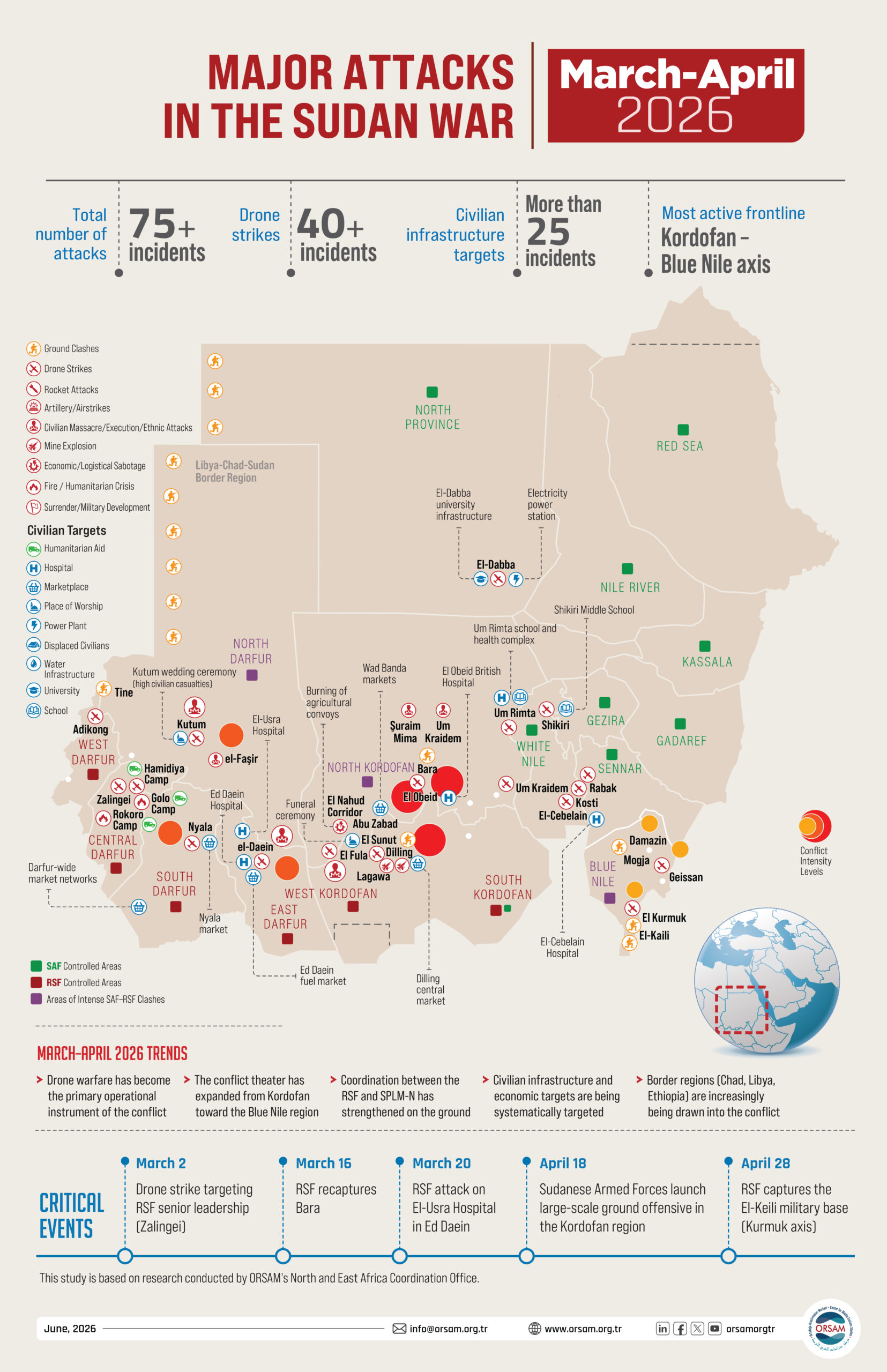
The March-April 2026 period demonstrates the deepening transformation of unmanned aerial vehicles (UAVs) from a merely tactical instrument into one of the principal determinants of the Sudan conflict. During this period, hospitals, marketplaces, educational institutions, refugee camps, and energy infrastructure across Darfur, North and South Kordofan, Blue Nile, and White Nile were directly targeted, rendering the humanitarian cost of the war more visible and widespread compared to previous months.
The “UAV attrition warfare” model that emerged in February expanded across a broader geographical area during March and April, with the Kordofan-Blue Nile axis becoming the central theater of conflict. While the Sudanese Armed Forces (SAF) achieved limited tactical gains in certain regions, the alliance between the Rapid Support Forces (RSF) and the Sudan People’s Liberation Movement-North (SPLM-N) maintained sustained pressure on multiple fronts through coordinated attacks.
Darfur: A Theater Marked by Systematic Targeting of Civilian Spaces
During March and April, Darfur became one of the most visible arenas of both high-intensity UAV attacks and civilian casualties. Attacks targeting marketplaces, hospitals, and civilian residential areas in cities such as Nyala, El Fasher, and Ed Daein demonstrate that the region has evolved not only into a military battleground but also into a zone of societal and economic collapse.
In particular, attacks targeting fuel markets and civilian areas in Ed Daein in mid-March, as well as strikes against displacement camps and civilian gatherings such as weddings in April, indicate that violence in Darfur has become increasingly indiscriminate and uncontrolled. Moreover, developments along the border regions—particularly the Chad–Sudan corridor—suggest that Darfur is no longer solely a theater of civil war, but also an arena shaped by broader regional security competition.
North and South Kordofan: The Main Axis of the War
During the March–April period, the center of gravity of the conflict shifted decisively toward the Kordofan axis. El Obeid, Dilling, Bara, and their surrounding areas emerged as focal points of both ground clashes and intensive UAV strikes. RSF control over Bara and clashes along the Dilling line in March directly affected the security of overland connections extending toward Khartoum.
At the same time, the Sudanese army’s ability to repel attacks around Dilling and secure limited advances demonstrates that the frontline is characterized less by static equilibrium than by fluctuating patterns of territorial control. In April, however, the SAF increasingly turned toward broader ground operations. Coordinated offensives in Kordofan indicate that the military has shifted from a primarily defensive posture toward a strategy centered on territorial recovery and battlefield reconfiguration.
Nevertheless, the targeting of hospitals, water infrastructure, and educational institutions along the Kordofan axis demonstrates that the distinction between military and civilian domains has effectively collapsed in this theater of war.
Blue Nile: An Emerging Frontline
The Blue Nile region emerged as one of the expanding frontlines of the conflict during March and April. Coordinated advances by RSF and SPLM-N forces along the Kurmuk, Geissan, and Ed Damazin corridor have elevated the strategic significance of the region.
The struggle for control over Kurmuk and increased mobility along the border areas indicate that Blue Nile is no longer merely a localized battlefield, but a broader security zone with implications extending toward the Ethiopian frontier. The conflict dynamics observed in this region point less toward conventional frontline warfare and more toward a strategy of attrition characterized by dispersed, highly mobile, and UAV-supported operations.
White Nile and Secondary Areas: The Deepening of Infrastructure Warfare
Attacks carried out in White Nile, Sennar, and West Kordofan demonstrate that the conflict is no longer confined to traditional frontlines. In particular, strikes targeting electricity power stations, fuel depots, and healthcare infrastructure indicate that the belligerents are increasingly pursuing strategies aimed at paralyzing the adversary’s capacity for civilian survival and governance.
These attacks suggest that the conflict is gradually evolving into a broader form of “infrastructure warfare,” in which economic and logistical systems have become central targets of military operations.
During March and April, the Sudanese Armed Forces (SAF) expanded their operations particularly across the Kordofan and Blue Nile axes. This development indicates a strategic transition from defensive containment toward calibrated counteroffensives.
The Rapid Support Forces (RSF), meanwhile, intensified attacks against civilian and semi-civilian targets in an apparent effort to raise the political, economic, and societal costs of the war. The concentration of attacks on hospitals, marketplaces, and educational institutions demonstrates that the RSF has adopted a strategy of attrition aimed at undermining societal resilience.
The SPLM-N, particularly in South Kordofan and Blue Nile, has increasingly operated in coordination with the RSF, thereby emerging as a complementary and balancing actor along the southern front. This development points to the gradual institutionalization of alliance structures within the conflict.
In the short term, clashes are expected to intensify along the El Obeid–Dilling–Bara corridor in Kordofan and the Kurmuk–Geissan axis in Blue Nile. In the longer term, the conflict is likely to evolve into a more fragmented, technology-driven, and civilian-cost-intensive form of warfare.
March and April 2026 marked a phase in which the Sudanese civil war expanded both geographically and operationally. During this period, the conflict evolved beyond the struggle for control over specific urban centers and increasingly transformed into a multilayered confrontation centered on airspace dominance, logistical corridors, and societal infrastructure.
The coordinated offensives of the RSF and SPLM-N, coupled with the expanding operations of the SAF, demonstrate that the conflict is becoming progressively more complex and multidimensional. In this context, instability in Sudan is deepening not only through shifting frontlines, but also through the systematic targeting of civilian living spaces and the collapse of critical infrastructure.
Accordingly, the trajectory of the Sudan crisis in the coming period should be analyzed not solely through military developments, but also through the lenses of humanitarian access, infrastructure security, and evolving regional dynamics.


All Rights Reserved 2012 - 2026 | Orsam