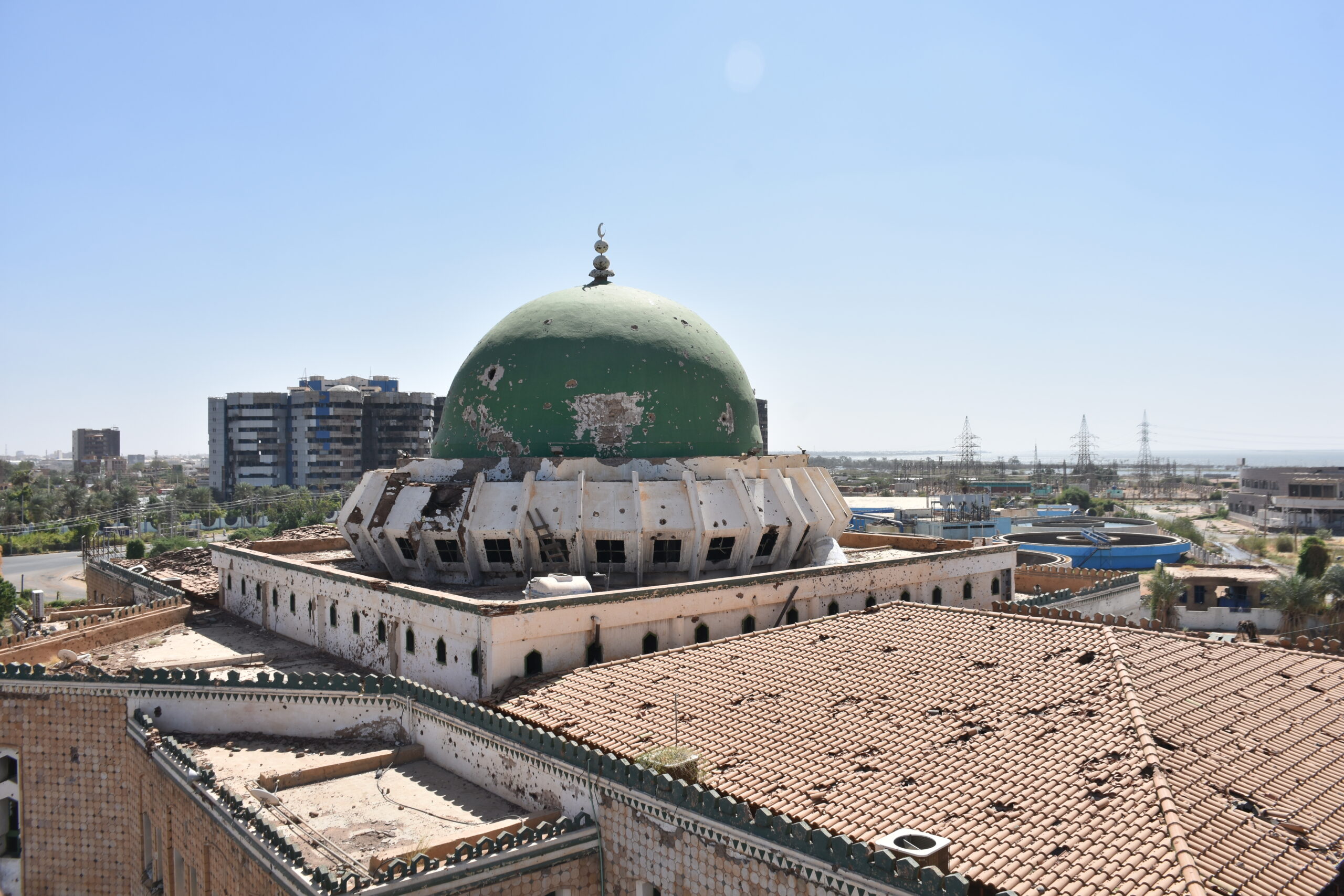
The war in Sudan, which began as a military power struggle in April 2023, has evolved into a deepening state collapse and societal devastation. The Rapid Support Forces’ (RSF) capture of el-Fasher on Oct. 26–27, 2025, marks a turning point that has fundamentally altered the understanding of authority and sovereignty, not only in Darfur but across Sudan. The RSF’s control of el-Fasher has also heightened the likelihood that the country could effectively split into two separate authorities, a division reinforced by the presence of a parallel government. At this stage of the conflict, civilians have become primary targets, and the humanitarian crisis has surpassed critical levels. Observers say the international community’s ineffectiveness and delayed responses are a key factor in bringing Sudan to its current state.
The siege of el-Fasher lasted more than a year. Hunger, thirst, and shortages of medicine were systematically used as weapons, and aid deliveries were blocked. According to the U.N., more than 250,000 civilians, including half children, were trapped in the city. The RSF built a 56-kilometer earthen barrier, completely isolating the city from the outside world and preventing food and medicine from entering. This approach shows that the war has shifted from a purely military conflict to an unethical strategy aimed at controlling civilians through pressure and starvation.
Following the RSF’s takeover of el-Fasher, reports indicate waves of mass executions, targeted assassinations, and systematic violence in the city. The killing of former lawmaker Siham Hassan Hasballah Ali is one of the most striking examples of the targeting of actors coordinating civilian aid. The situation underscores the RSF’s aim not only to seize military power but also to monopolize social authority, viewing any attempt at civilian-led opposition as a threat. The detention of journalists, the collapse of communication infrastructure, and the bombing of hospitals point to a strategy of information blackout and a fear-based governance model on the ground.
The U.N. High Commissioner for Human Rights and various independent organizations have reported evidence that RSF fighters carried out ethnically targeted executions. These allegations have revived debates over the genocide witnessed in Darfur in the early 2000s. Historical memory shows how destructive the unchecked authority of non-state armed groups can be in the region. The events unfolding today are seen as a grim repetition of a period once promised to “never happen again.”
Meanwhile, the Sudanese army has become increasingly passive. General Abdel Fattah al-Burhan defended the decision to withdraw from el-Fasher to a “safer area,” framing it as a tactical move. But the retreat left civilians unprotected and eroded public confidence in the military. As the state’s claim to legitimacy weakens, the RSF’s goal of establishing a Darfur-centered “regional administration” is gaining ground, signaling the emergence of a parallel authority that threatens Sudan’s territorial integrity.
A moral test for the international community
International responses have been extremely limited. U.N. Secretary-General António Guterres described developments in el-Fasher as “horrifying,” while the African Union warned of “crimes against humanity.” The U.S., European Union, Türkiye, and Egypt have called for an immediate cease-fire, and Chad has strengthened border security in preparation for a new wave of refugees. But these statements have little capacity to alter the dynamics of violence on the ground. The gap between diplomatic rhetoric and actual coercive power is widening, facilitating the RSF’s institutional consolidation in the field.
One of the greatest dilemmas facing the international system is its continued framing of Sudan’s war as a power struggle between two generals. In reality, what is happening goes far beyond a narrow elite rivalry. It is a process of mass punishment carried out along lines of social groups, ethnic identities, and humanitarian values. Preventing this humanitarian catastrophe is therefore not just a matter of political negotiation — it is a moral test of international legitimacy.
Possible scenarios
The fall of el-Fasher is not only a turning point in Sudan’s war but also a development that opens the door to dark scenarios for the country’s future. As of now, there is neither a sufficient balance on the ground nor a reliable dialogue framework at the negotiating table to end the fighting. Consequently, Sudan faces three possible scenarios: de facto division, a forced cease-fire, or renewed escalation.
The first scenario is the effective division of Sudan into two authorities. The RSF could consolidate control over Darfur and the southern regions, while the army, led by General Burhan, dominates the north and east. This could become a new version of the trauma Sudan experienced with South Sudan’s secession in 2011. The country could fragment into ethnically based administrative zones, forming a loose confederation controlled by armed actors. This scenario would deepen the humanitarian crisis and entrench ethnic cleansing in Darfur, while the disintegration of state authority could push Sudan toward a Somalia-style collapse.
The second scenario involves a forced cease-fire shaped by international pressure. Coordinated efforts by actors such as Egypt, Chad, Gulf countries, Türkiye and the U.S. could compel the parties into a temporary pause. However, such a cease-fire would be meaningful mainly for protecting civilians and opening humanitarian aid corridors, rather than guaranteeing lasting peace. Still, this scenario could provide a “breathing space,” allowing the parties to return to diplomatic negotiations. In that case, it would be critical for regional actors — particularly the African Union and the Intergovernmental Authority on Development (IGAD) — to resume their mediation roles.
The third and most risky scenario is a renewed escalation of the war toward the capital. If the RSF carries the momentum it gained in el-Fasher eastward, new fronts could open along the Khartoum and Nile Valley axis. This could plunge Sudan into large-scale urban warfare. Urban warfare, supported by airstrikes and artillery, would not only increase civilian casualties but also irreversibly destroy the country’s infrastructure. This scenario would turn the conflict from a “Darfur-centered crisis” into a nationwide catastrophe.
The common thread among these three scenarios is that Sudan’s chances of reunifying under a strong, functional central authority in the near future are extremely slim. As the state’s institutional capacity collapses, economic decline, mass displacement, and the humanitarian crisis are creating a security threat that extends beyond the country’s borders. For fragile neighbors such as Chad, South Sudan, and the Central African Republic, the war represents a direct import of instability. Consequently, the conflict in Sudan is evolving from a domestic issue into a regional crisis that could reshape the overall “security architecture of the Sahel-Red Sea corridor.”
Ultimately, Sudan’s future will be tested not by military victories, but by humanitarian conscience. If the international community continues to view the conflict as merely “a power struggle between two generals,” the fall of al-Fasher could become a symbol of Sudan’s permanent division and of millions of people trapped between life and death. What happens next will depend on whether diplomatic steps are taken to rebuild peace. Sudan is no longer just a battlefield — it is a mirror reflecting the international system’s sense of responsibility.
This opinion piece was published on Nov. 3, 2025, on the Anadolu Agency website under the headline: “Faşir sonrası Sudan: İki generalin savaşı değil, uluslararası toplumun ahlak sınavı”