Filtre

Type the word you want to search for
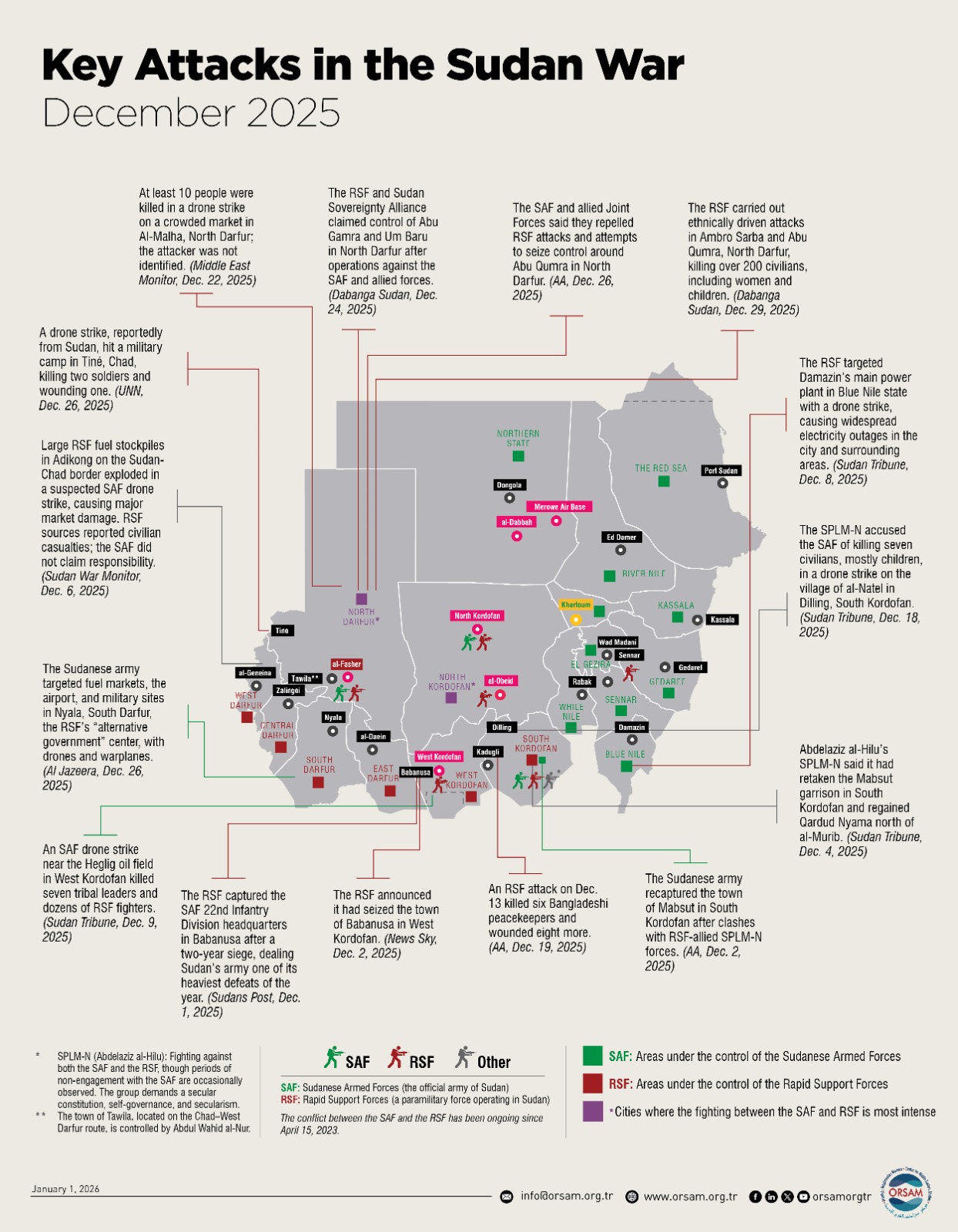
December 2025 marked a turning point in the Sudan war, with profound shifts in the military and political balance. In the first days of the month, the fall of the city of Babanusa in West Kordofan, along with the headquarters of the Sudanese Armed Forces (SAF)’ 22nd Infantry Division, to the Rapid Support Forces (RSF) was recorded as one of the most severe military defeats of the year, second only to Al-Fasher. This development was not merely a tactical gain; it represented a strategic rupture, signaling the collapse of the Kordofan front, the strengthening of the Darfur-Kordofan corridor and the encirclement of Khartoum from the west.
Throughout December, the fighting spread across West and South Kordofan, North and South Darfur, Blue Nile state and border regions, further reinforcing the war’s multifront and increasingly regionalized character. Alongside the RSF’s military gains, a surge in ethnically driven attacks underscored that the conflict had evolved beyond a purely military struggle into a process of social and demographic destruction.
West Kordofan (Babanusa-Heglig Corridor)
The most critical development of December was the fall of Babanusa on Dec. 1-2. The RSF captured the headquarters of the SAF’s 22nd Infantry Division, which it had besieged for more than two years, consolidating its control over West Kordofan. The loss of Babanusa was not only a military defeat but also marked the collapse of the SAF’s logistical backbone in Kordofan.
On Dec. 9, a SAF drone strike near the Heglig oil field killed seven tribal leaders and numerous RSF fighters, signaling that the army had shifted toward a new strategy targeting energy assets and tribal power centers. Despite this, the loss of Babanusa could not be reversed, and West Kordofan effectively became the RSF’s main supply corridor.
South Kordofan (Mabsut-Kadugli-Dilling Corridor)
In December, South Kordofan witnessed intense fighting involving the SAF, the SPLM-N*and the RSF. On Dec. 2, the Sudanese army’s recapture of the strategic town of Mabsut from the SPLM-N stood out as a brief success, but on Dec. 4 the Abdelaziz al-Hilu-led SPLM-N announced it had retaken the Mabsut garrison and the Qardud Nyama area. The development underscored that the SAF’s gains in South Kordofan were not sustainable.
On Dec. 13, an RSF attack in Kadugli killed six Bangladeshi UN peacekeepers, highlighting the international dimension of the conflict. Around the same time, the SPLM-N accused the SAF of targeting civilians, mostly children, in a drone strike on the village of al-Natel near Dilling. These mutual accusations illustrate that South Kordofan has become a high-risk, largely uncontrolled conflict zone.
Darfur (North and South Darfur)
In December, Darfur became a focal point for both military clashes and ethnically driven mass violence. On Dec. 22, an unexplained drone strike on a market in Al-Malha, North Darfur, killed at least 10 civilians, underscoring how air threats have become routine in the region.
Between Dec. 24 and 26, the RSF and the Sudan Sovereignty Alliance claimed to have seized control of Abu Gamra and Um Baru, while the SAF and allied Joint Forces of Armed Movements announced they had halted the RSF’s advance around Abu Qumra. On Dec. 26, the Sudanese army targeted fuel markets, the airport, and military sites in Nyala, which had emerged as an RSF “alternative government center,” signaling the start of a new air campaign against administrative hubs in Darfur.
The deadliest humanitarian toll of the month occurred on Dec. 29. Ethnically driven attacks carried out by the RSF in the Ambro Sarba and Abu Qumra areas killed more than 200 civilians, including women and children, highlighting that the war in Darfur has clearly reached the scale of mass violence and ethnic cleansing.
Blue Nile and Border Regions
On Dec. 8, the RSF targeted the main power plant in Damazin with a drone strike, causing widespread electricity outages across Blue Nile state. The attack underscored the war’s growing impact on infrastructure and energy security.
On Dec. 6, a suspected SAF drone strike caused RSF fuel stockpiles to explode in Adikong, a town on the Sudan-Chad border, showing that border areas have also become active conflict zones. On Dec. 26, a drone strike reportedly originating from Sudan targeted a military camp in Chad’s Tine town, signaling that the fighting has taken on a direct cross-border dimension.
Short-term outlook: The RSF is expected to increase pressure on the western outskirts of Khartoum via West Kordofan, while the SAF will likely continue seeking to balance the conflict in Darfur and South Kordofan through air power.
Long-term outlook: Sudan is effectively entering a highly decentralized and fragmented war structure. The prospects for a military solution are weakening, while humanitarian and demographic costs are rising rapidly.
In conclusion, December 2025 marked a month in the Sudan war where strategic thresholds were crossed. The fall of Babanusa, ethnic massacres in Darfur, and cross-border attacks indicate that the country is now experiencing not only a civil war but also a process of regional and societal collapse. The prospects for peace in Sudan will depend less on military balances and more on the opening of humanitarian corridors, protection of civilians, and the activation of regional mediation mechanisms. ORSAM will continue to monitor and analyze this situation monthly.
The SPLM-N refers to the Sudan People’s Liberation Movement-North led by Abdelaziz al-Hilu. While it initially remained independent during the early phase of the war, it is now seen operating in coordination with the RSF. Al-Hilu is both a rebel leader who has long fought the Arab-centered Sudanese state in the Nuba Mountains of South Kordofan and a prominent post-Bashir transitional figure advocating a secular system based on the separation of religion and the state.
All Rights Reserved 2012 - 2026 | Orsam