
INTRODUCTION: A New Phase in the Sudan War: From Horizontal Expansion to Deepening and Urban Sieges
September 2025 marked a turning point in the Sudanese war, as violence intensified and fighting spread into urban centers. Areas around Al-Fasher, the Kordofan corridor, and the suburbs of Khartoum were heavily targeted by airstrikes, unmanned aerial vehicles (UAVs), and artillery bombardments. The Rapid Support Forces (RSF) continued their urban pressure strategy by targeting civilians and international organizations, while the Sudanese Armed Forces (SAF) launched counteroffensives using air power and allied local militias. The conflict now appeared concentrated not only on military fronts but also within civilian zones, deepening the humanitarian crisis.
The Extent of Geographical Expansion and the Intensity of the Attacks
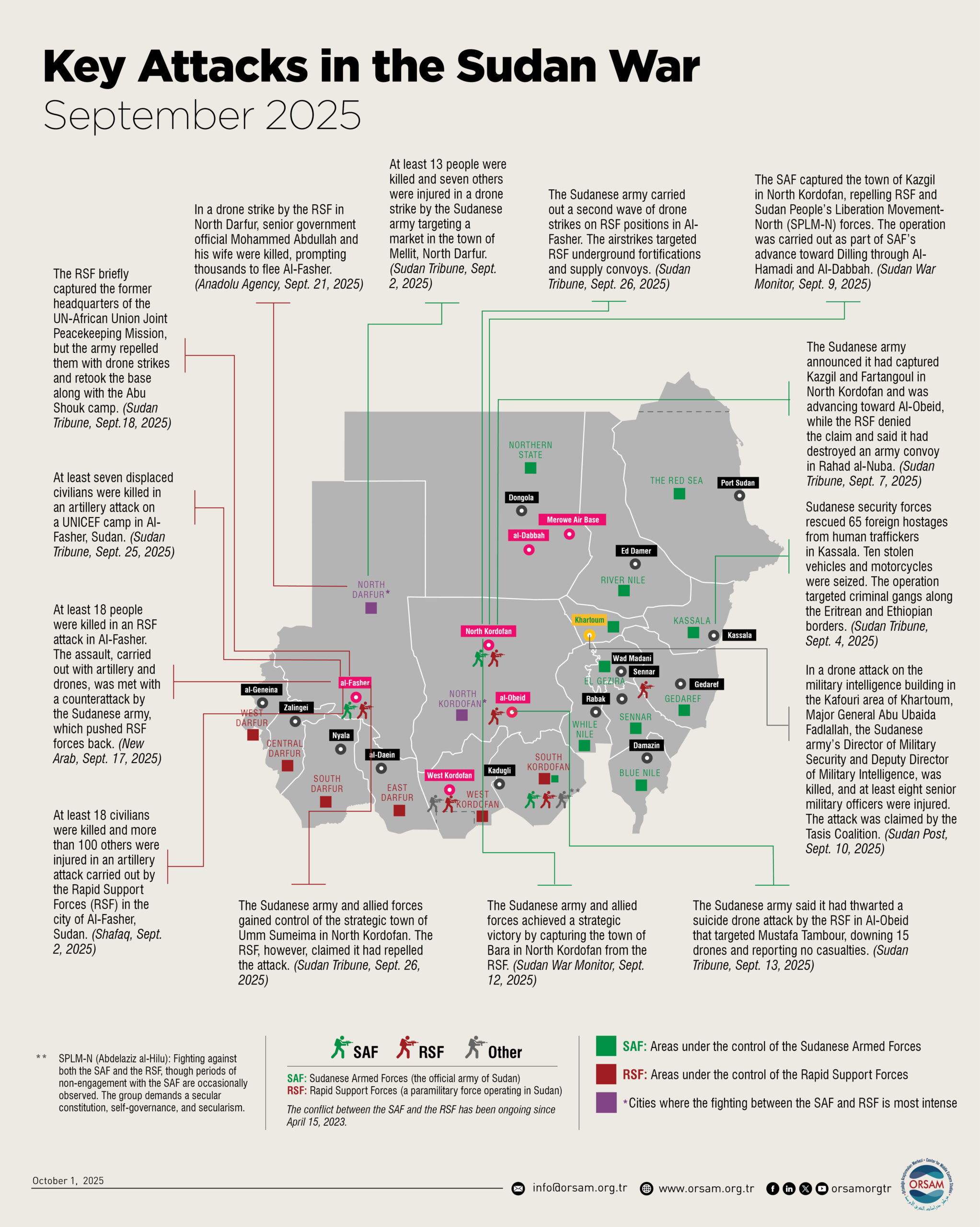
Throughout September, clashes were reported in more than 10 states. The geographic diversity of the conflict signals a shift from a phase of “horizontal expansion” to one of “deepening and urban siege.”
- North Darfur (Al-Fasher–Mellit axis):
Repeated drone and artillery attacks by the RSF killed dozens of civilians. In retaliatory airstrikes by the SAF, over 20 people were killed. Shelling also struck a UNICEF camp, resulting in child casualties among displaced populations.
- Kordofan:
The SAF recaptured strategic areas in the Kazgil and Umm Sunein corridor, halting RSF advances. However, RSF forces regrouped in rural Kordofan and launched renewed ambushes on SAF convoys.
- Khartoum:
A drone strike on the Kafouri area targeted senior military officials, reflecting the RSF’s continued efforts to weaken the government’s command structure.
- North Darfur and Blue Nile axis:
Attacks on UN and aid organization convoys disrupted humanitarian operations along internal routes and border crossings.
This geographic pattern shows that urban warfare is defining the Al-Fasher and Khartoum fronts, while control of arterial routes remains decisive in Kordofan.
Actors in the War: Tactics, Alliances, and Foreign Support
Sudanese Armed Forces (SAF):
- Conducted coordinated airstrikes in Mellit, Umm Sunein, and Barra targeting RSF positions.
- Maintained partial advances in Kordofan thanks to air superiority.
- Strengthened cooperation with allied militias, particularly local forces opposing the Sudan People’s Liberation Movement-North (SPLA-North).
Rapid Support Forces (RSF):
- Carried out heavy attacks on civilian areas in and around Al-Fasher.
- Targeted the UNICEF camp and launched UAV assassinations against government officials as part of a morale-based pressure campaign.
- Secured supply lines through Libya and Chad; renewed activity by Wagner-linked elements near the South Darfur–Central African Republic border raised questions about RSF’s external connections.
Other Actors:
- Criminal and smuggling networks along the Eritrean and Ethiopian borders continue to exploit the conflict for economic gain.
Civilian Casualties and Humanitarian Situation
September 2025 saw one of the highest civilian death tolls since the war began.
- In the Al-Fasher UNICEF camp attack, numerous civilians, including children, were killed.
- An airstrike on the Mellit market killed 13 and wounded seven.
- The targeting of displaced convoys along the Kordofan–Al-Fasher route revealed a collapse in humanitarian corridors.
- Drone attacks in Khartoum by the RSF that killed senior military officials underscored the war’s expansion into the capital.
The humanitarian crisis now extends beyond food and shelter shortages — it encompasses severe insecurity and restrictions on freedom of movement.
Assessment and Outlook
- The RSF’s focus on urban assaults aims to offset its loss of rural initiative but drastically worsens civilian suffering.
- The SAF’s air superiority provides only temporary tactical advantages, as the multi-front nature of the war strains its resources.
- Although SAF advances in Kordofan are strategically important, the RSF’s mobile and decentralized structure complicates sustained territorial control.
- The reappearance of Wagner elements around Um Dafuq highlights the war’s growing regionalization, threatening the Chad–Central African Republic corridor and raising questions about the future trajectory of the Darfur conflict.
- The collapse of aid routes is likely to trigger mass displacement and famine in the coming months.
- Short-term projection: The SAF will likely continue its ground advance from Kordofan toward Al-Fasher, while the RSF will resort to drone and sabotage operations around Khartoum to disrupt morale and communication.
CONCLUSION
As of September 2025, the Sudanese war has evolved into a high-intensity war of attrition concentrated in urban centers, with civilians bearing the brunt of the violence. The situation signals a “new threshold” in the conflict — one defined by urban siege, humanitarian collapse, and deepened regional entanglements. Peace and humanitarian stability in Sudan will only be achievable through the restoration of control over both battlefronts and urban spaces. ORSAM will continue to monitor this process monthly, focusing on the actors, regions, and humanitarian dimensions of the war.