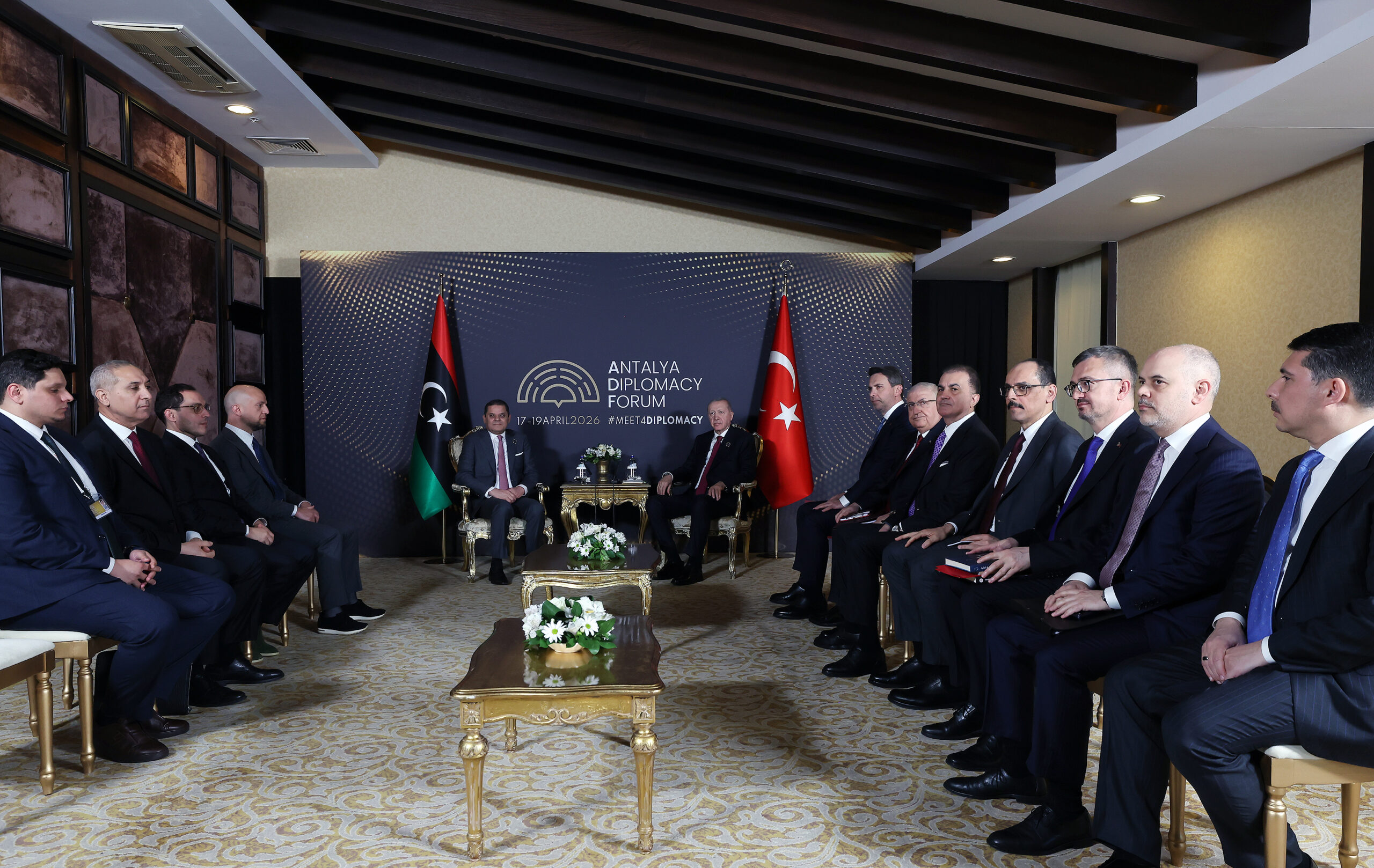
Nechirvan Barzani, the prime minister of the Iraqi Kurdistan Regional Government (KRG), paid an official visit to Turkey on July 30-31, 2013.
Barzani, who first met with Turkish Foreign Minister Ahmet Davutoğlu during an iftar dinner on July 30, met with Turkish Prime Minister Recep Tayyip Erdoğan at a meeting which was also attended by Foreign Minister Davutoğlu, National Intelligence Organization (MİT) Undersecretary Hakan Fidan and Energy and Natural Resources Minister Taner Yıldız on July 31.
While Syria and Syrian Kurds were high on the agenda during the talks, the Kurdish National Conference, the political and energy-related relations between Turkey and the KRG and the developments in Iraq were addressed. Moreover, a written statement by the Ministry of Foreign Affairs noted that Turkey and the KRG share common concerns and positions regarding the developments in Syria and in the north of Syria.
The developments in Syria and in the north of Syria, which are also high on the agenda of world public opinion, came to the forefront at the meeting. That the visit was paid right after a visit by Salih Muslim, leader of the Democratic Union Party (PYD), which is known to be striving to form an autonomous administration in the north of Syria and has come to the fore as the driving force of the Syrian Kurdish movement during the post-2011 period, is of great importance in terms of Kurdish policy within the regional equation.
These days, when preparations for the Kurdish National Conference set to be held in Arbil have been made, attention needs to be paid to the timing of both visits in order for Turkey to be able to follow and control the process closely.
Statements made after those visits have raised some question marks. The characteristics of the “common concerns and positions” shared by Turkey and the KRG are ambiguous. One can clearly assert that both parties have adopted a common approach towards the change of regime in Syria. However, it is hard to say the same thing for Syrian Kurds for now.
Turkey has explicitly stated at every platform that it does not lean towards the creation of an autonomous administration in the north of Syria. The KRG, on the other hand, does not seem to be against such a formation. In fact, it appears to be supporting the possibility of the formation of an autonomous Kurdish administration in Syria. If the KRG shares common concerns and positions with Turkey, then it means that it contradicts its own discourse. However, one should not overlook a detail at this point.
Considering the relations between the KRG and the PYD and the KRG's policy towards the Syrian Kurds in the post-2011 period, it can be seen that the KRG's common position and concern with Turkey is not for an autonomous administration in the north of Syria. At this point, it might be suggested that the main concern of the KRG is the possible creation of an administration that could limit its influence on Syrian Kurds.
It is known that the PYD does not want Iraqi Kurds to have control over Syrian Kurds, despite its relations with the KRG. Therefore, the PYD was not able to reach an agreement with other Syrian Kurdish parties, supported by the KRG, for a long time.
In February 2013, the PYD and other Syrian Kurdish parties reached an agreement as a result of the meetings held in Arbil, and the Kurdish Supreme Council, which would be in charge of the Kurdish regions in Syria, was formed.
It is said that all Syrian Kurdish parties are represented at the council. However, the Popular Protection Units (YPG), which is the military branch of the PYD, became the only defense force of the Supreme Council. The PYD received great support and prestige all across the Kurdish regions as a result of the advance of the YPG. This situation led to a major disagreement between the PYD and the KRG.
Turkey's concern, on the other hand, might be that the PYD, having an organic link with the Kurdistan Workers' Party (PKK) terrorist organization, could hold power on its own in a possible autonomous Kurdish region in the north of Syria because the terrorist PKK having control over a possible administration in Syria would have a direct negative impact on the national security of Turkey. This might also disrupt the ongoing resolution process initiated by the government in Turkey.
Moreover, it would be right to say that one of the main concerns in terms of foreign policy is the possibility that the PYD could reach an agreement with the regime of Syrian President Bashar al-Assad. While Turkey's Syria-related political plans are based on the toppling of the Assad regime and the opposition is losing ground, Turkey's Syria policy might come to nothing as a result of a possible agreement between the PYD and Assad.
Also, such a situation could create a position that might bring about a regional polarization. If the PYD cannot find foreign support, it might establish close relations with Assad. He is already known to be leaning towards the idea. If a conflict occurred between the PYD and the KRG, the Iraqi central government might support the PYD to drive the KRG into a corner. From this point of view, it would not be wrong to suggest that the PYD could win Iran's support as well.
Also, considering that relations between Turkey and the Iraqi central government have not been going well and Iraq has been opposing Turkey's regional policies for a couple years, it should be suggested that the Iraqi central government could support the PYD to gain an advantage over Turkey. Thus, the KRG, which tries to maintain the stabilization and keep the advantages it has gained, could face problems in terms of both its internal politics and also the balances within Iraq.
In such a case, it is likely that the Turkey-KRG alliance would be needed against the cooperation between Syria-PYD-Iraq-Iran within the Middle East equation. It is likely that the limits of such a polarization that could take place in the Middle East would not be limited only to those actors. It is obvious that polarization in the Middle East will further deepen the problems in the region.